Offline Arcade Games iPhone: Play Anywhere Without Connection

Photo by Senad Palic on Unsplash
Offline Arcade Games for iPhone: Play Anywhere Without Connection
The appeal of arcade games on iPhone is simple: they’re designed for short bursts of focused play, and they don’t need a server connection to deliver that. Whether you’re on a flight, in a subway, or just tired of WiFi dependency, offline arcade games on iOS let you play exactly when and where you want. The best ones are premium purchases—no ads, no energy timers, no mandatory online check-ins—which means you own the game outright and it works the same way five years from now.
This guide covers the arcade-style games worth your money, why offline-first design matters, and which titles actually deliver on the promise of connection-free play.
Why Offline Arcade Games Matter
Free-to-play games have trained iPhone users to expect interruptions: ad breaks, energy meters that force you to wait, daily login bonuses that punish you for not playing. Offline arcade games reject that entirely. A premium arcade title works the moment you tap it, whether you have signal or not, and doesn’t ask you to come back tomorrow to get your “daily reward.”
The technical constraint of offline-only actually improves arcade design. Developers can’t lean on server-side progression tracking or cloud saves to cover for weak core mechanics—the game has to be fun right now, on its own, or it fails. According to discussions on r/iosgaming, players consistently report that premium offline arcade games feel “more polished and focused” than their free-to-play counterparts, citing the absence of monetization friction as a key factor in design quality.
The other advantage is longevity. A game you buy today will still work the way it shipped in 2026, 2030, and beyond. Server-dependent games can shut down. Offline games can’t.
Core Mechanics That Work Without Connection
Arcade games thrive offline because they’re built around immediate, self-contained loops: you start a run, you play until you lose or win, the game is over. No waiting for other players. No synchronizing progress across devices. No checking in with a server to unlock the next level.
The best offline arcade titles lean into this constraint. They use procedural generation to create variety within a single session (so replays feel fresh), tight controls that reward skill over time investment, and scoring systems that give you a reason to play again without forcing you to.
Physics-based arcade games—where gravity, momentum, and collision are the core mechanic—work particularly well offline. The simulation runs on your device, no network needed. Strategy-based arcade games (turn-based, puzzle-arcade hybrids) also thrive without connection, since there’s no real-time opponent to sync with.
Quick Picks: Choose by Your Play Style
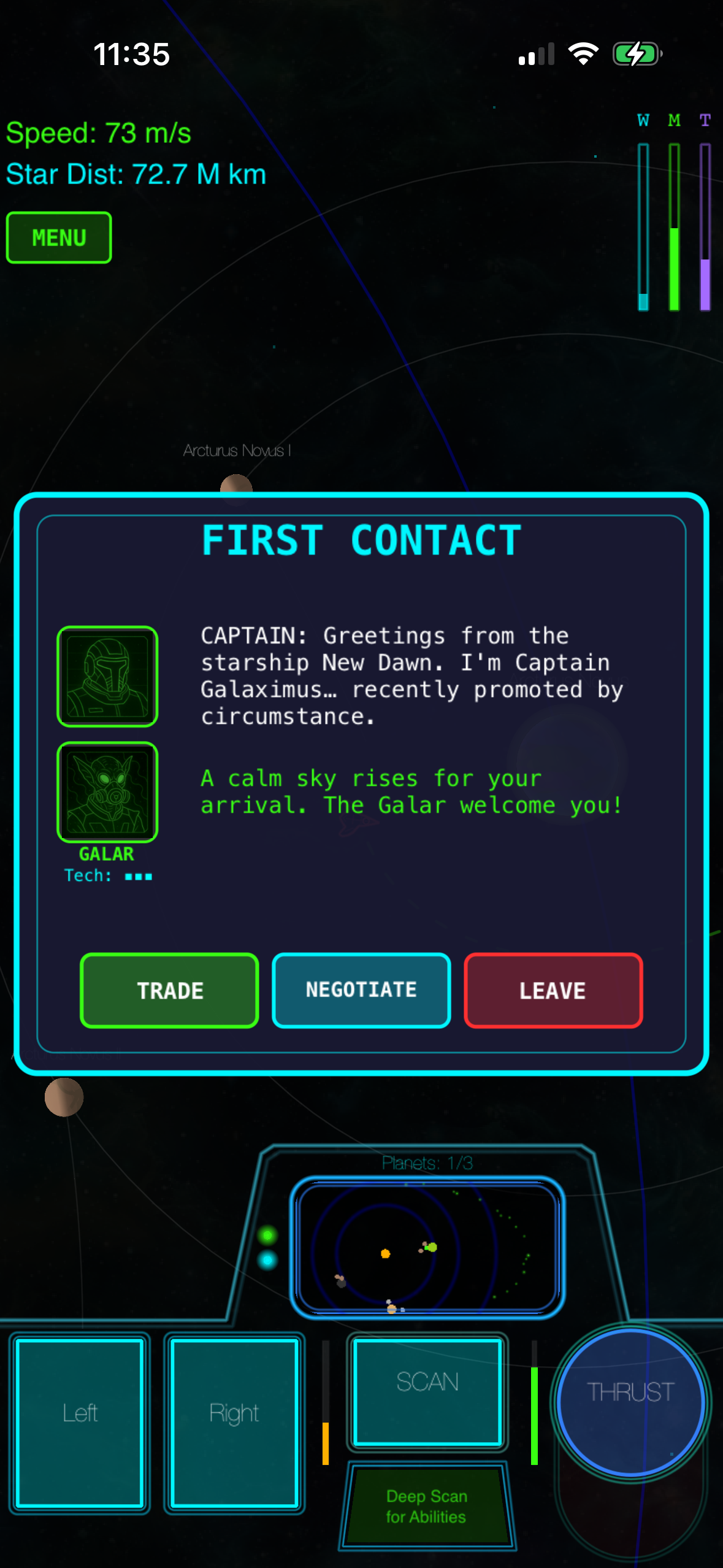
Best for Physics Mastery: Galaximus If you want an offline space-arcade game where gravity actually matters, Galaximus is the most technically rigorous option on iPhone. Every celestial body obeys real orbital mechanics—planets orbit suns, moons orbit planets, asteroids tumble through gravity wells, and your ship is subject to all of it. The learning curve is real (you’re not just pointing and tapping), but the payoff is a kind of mastery no faked-physics space game can offer. Each playthrough generates a unique 8-system campaign. Works flawlessly offline with no connection check. Best for players who want positioning and momentum to matter more than reflexes.
Best for Roguelike Runs: Hades Roguelike action-arcade with procedurally generated dungeon runs, permanent progression, and a narrative that unfolds across dozens of runs. Each run takes 20–40 minutes; permanent upgrades between runs mean you feel progression even when you fail. Works offline, no connection required. Best for players who want replayability without daily login gates.
Best for Touch-Only Play: Asteroids: Recharged Respects the classic lineage while adding modern visual clarity (vector graphics, crisp neon lines) and responsive touch controls. Straightforward mechanic (rotate, thrust, shoot) scales difficulty gradually, making it ideal for beginners. Procedural asteroid spawning keeps runs fresh. Works offline, no IAP. Best for players who want instant gratification and don’t want to learn complex controls.
Best for Puzzle-Arcade Hybrid: Duet A rotating-rings puzzle-arcade game where two circles orbit a center point and you rotate them to dodge incoming obstacles. Meditative and demanding at once. Sessions are 5–15 minutes per level. Works offline, no ads, no IAP. Best for players who prefer precision timing over reflexes and want to play in short bursts.
Best for Deck-Building Strategy: Slay the Spire A deck-building roguelike where each run is a procedurally generated gauntlet of card-based encounters. No two runs play the same. Each run takes 30–60 minutes. Offline, no connection required. Best for players who want strategic depth and don’t mind turn-based pacing.
Best for Budget Conscious: Two Dots A minimalist puzzle-arcade game where you connect dots to clear the board. The mechanic is simple; the difficulty curve is brutal. Sessions are 3–10 minutes per puzzle. Works offline, no connection required. Best for players who want quality arcade gameplay at the lowest price point.
Galaximus: Real Physics, Real Mastery
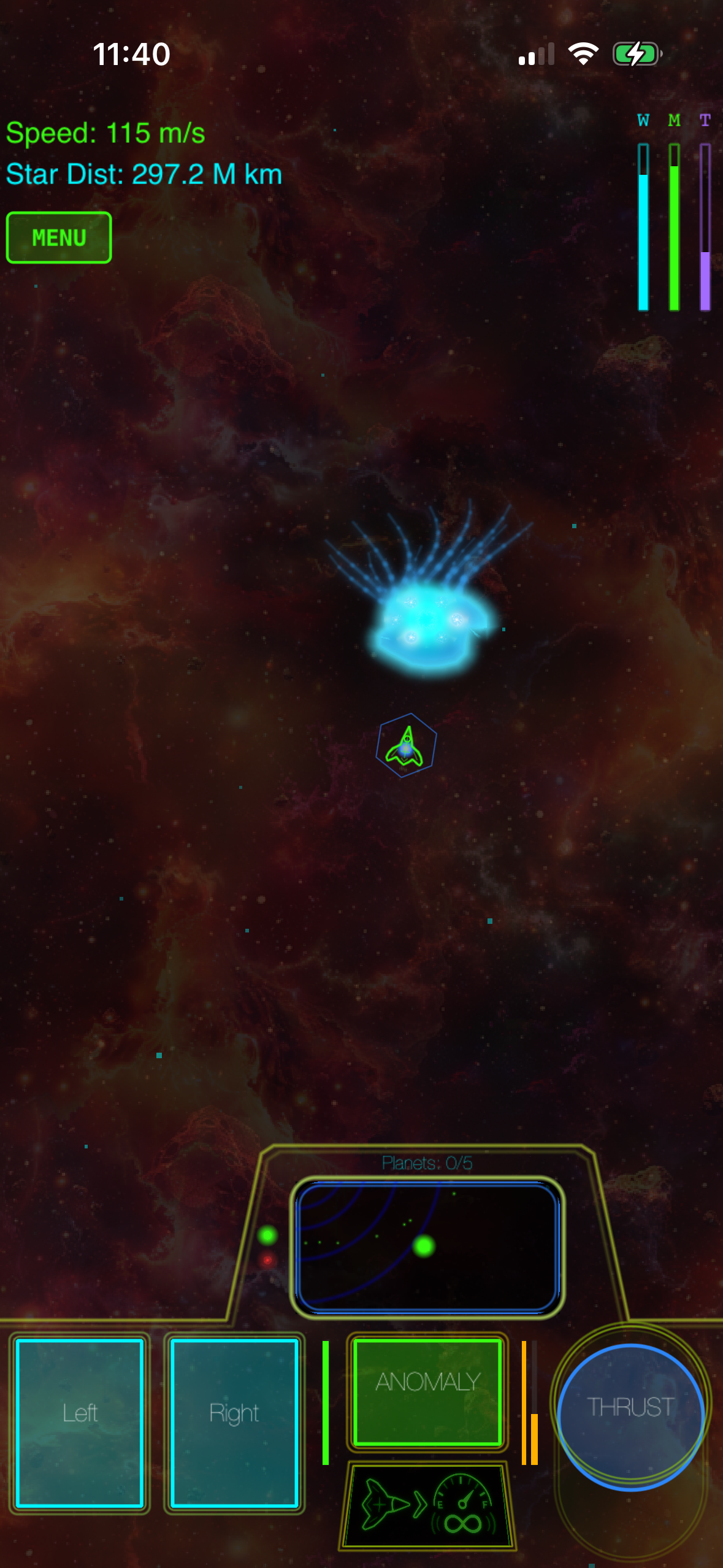
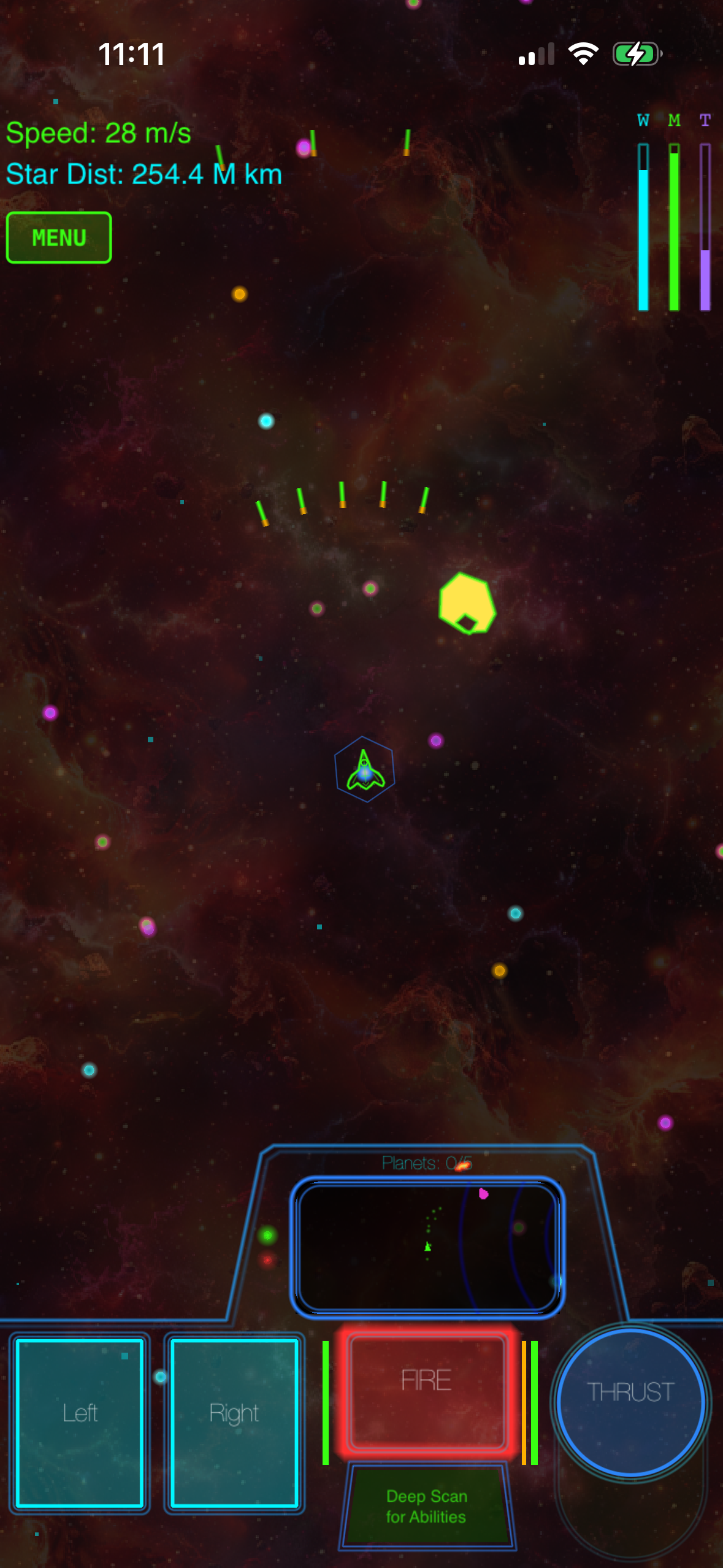
Galaximus (, one-time purchase) is the most technically rigorous offline space-arcade game on iPhone. Every celestial body obeys real orbital mechanics—planets orbit suns, moons orbit planets, asteroids tumble through gravity wells, and your ship is subject to all of it. The learning curve is steep (you’re managing momentum, gravity assists, and orbital decay), but the payoff is a kind of mastery no arcade game with faked physics can offer.
Gameplay & Session Length: Each campaign consists of 8 procedurally generated star systems. A full campaign takes 45–90 minutes depending on your skill level. You can pause mid-campaign and resume later—progress is saved locally on your device.
Control Scheme: Touch controls use a two-finger gesture to set thrust vector and magnitude; tapping the screen fires your main weapon. MFi controller support is native—the stick controls thrust direction and magnitude with precision, making the slingshot maneuver feel natural. Controller play is recommended for longer sessions.
What Sets It Apart: Unlike other space-arcade games that simulate gravity as a visual effect, Galaximus uses real N-body physics. Your trajectory is determined by actual gravitational pull, not scripted waypoints. This means every approach to a planet is unique, and mastery comes from understanding orbital mechanics, not memorizing patterns. No IAP, no ads, no connection required.
Classic Arcade Lineage: Games That Respect Their Heritage
The strongest offline arcade games often trace back to 1979–1985 arcade formats—Asteroids, Defender, Tempest, Lunar Lander—and rebuild them with modern controls and visual polish. These games work offline by default because the originals had no network; the constraint is baked into the genre.
Asteroids: Recharged Straightforward mechanics: rotate, thrust, shoot. Procedural asteroid spawning keeps runs from feeling repetitive. Sessions are 10–20 minutes. Touch controls are responsive; MFi controller support is excellent. No IAP, no ads. Best for beginners and players who want instant gratification.
Lunar Lander: Beyond Takes the gravity-based descent mechanic and builds a campaign around it. Each landing site has different gravity, wind, and hazards. Sessions are 5–15 minutes per landing. Physics reward patience and positioning over twitch speed. Touch controls work well; controller support is available. No IAP, no ads.
Defender Reborn Modernizes the side-scrolling defender format with touch-friendly controls and procedural enemy waves. Faster-paced than the Asteroids descendants but still rewards learning the rhythm. Sessions are 8–15 minutes. Works offline, no IAP. Best for players who want faster action than classic lineage games.
All three work offline, use procedural generation to create variety, and are premium purchases with no IAP.
Vector Graphics and Minimalist Aesthetics
Some of the sharpest offline arcade games strip away photorealism entirely and lean into vector graphics and minimal UI. This aesthetic choice isn’t just style—it’s practical. Vector games are lightweight, they scale perfectly to any screen size, and the visual simplicity actually sharpens the gameplay focus. You’re not distracted by texture detail; you’re watching the core mechanic.
The trade-off is that minimalist visuals can feel cold or abstract to players accustomed to detailed graphics. But for arcade gameplay, this constraint is a feature: your brain processes the game state faster when there’s less visual noise.
Duet Two circles orbit a center point; you rotate them to dodge incoming obstacles. Meditative and demanding. Sessions are 5–15 minutes per level. Minimalist vector aesthetic reduces cognitive load, letting you focus on timing. Works offline, no ads, no IAP.
Two Dots Connect dots to clear the board. Simple mechanic, brutal difficulty curve. Sessions are 3–10 minutes per puzzle. Minimalist design means no distracting animations—just dots and lines. Works offline, no connection required.
Vector Guide a figure through a minimalist cityscape using parkour mechanics. Timing and momentum are everything. Sessions are 5–20 minutes depending on level difficulty. Pure vector lines; no texture detail. Works offline, no IAP.
These games prove that offline arcade design doesn’t need flashy graphics—it needs sharp mechanics and visual clarity. The minimalist aesthetic actually enhances that by removing visual friction.
Roguelike Arcade: Procedural Runs and Permanent Death
Roguelike arcade games combine the arcade loop (one run, start to finish) with procedural generation (no two runs are identical) and permanent death (when you lose, you lose). This structure is perfect for offline play because the entire game state lives on your device—no server, no cloud saves, no sync issues.
The best roguelike arcade games let you unlock permanent upgrades between runs (so you feel progression even when you fail) without locking you behind energy timers or daily gates.
Hades Roguelike action-arcade with procedurally generated dungeon runs, permanent progression, and a narrative that unfolds across dozens of runs. Each run takes 20–40 minutes; a full playthrough (all story endings) requires 40–60 runs. Works offline, no connection required. Difficulty is moderate to hard; beginner-friendly with adjustable difficulty settings. MFi controller support is excellent. Best for players who want action-arcade gameplay with narrative depth.
Slay the Spire Deck-building roguelike where each run is a procedurally generated gauntlet of card-based encounters. No two runs play the same. Each run takes 30–60 minutes. Turn-based pacing means no reflexes required. Works offline, no connection required. Difficulty is moderate to hard; strategy matters more than execution. Best for players who want strategic depth and don’t mind slower pacing.
FTL: Faster Than Light Space-roguelike where you pilot a ship through procedurally generated star systems, managing resources and tactical decisions. Each run takes 30–90 minutes. Brutal difficulty; permanent death is final. Turn-based combat with real-time decision pressure. Works offline, no connection required. Best for players who want high difficulty and don’t mind losing runs to learn the game.
All three reward repeated play without forcing daily login cycles. Each run is self-contained, which makes them perfect for offline play—you can pause mid-run, close the app, and come back whenever.
Controller Support for Serious Play
If you’re playing arcade games for hours at a time, a controller transforms the experience. Touch controls are fine for short sessions, but physical buttons and sticks reduce hand fatigue and let you focus on the game instead of the interface.
The best offline arcade games support MFi controllers (the iPhone standard). This means you can pair a physical controller—an 8BitDo, a Backbone, or any MFi-certified gamepad—and play like you’re on a console.
Galaximus supports controllers natively. The orbital mechanics reward precise stick input; a controller makes the slingshot maneuver feel natural.
Asteroids: Recharged supports MFi controllers and plays beautifully with a gamepad. The rotation and thrust feel responsive; shooting is snappy.
Hades has full controller support and is arguably better with a gamepad than with touch. The action is fast enough that button response time matters.
If you’re serious about arcade play, a controller is worth the investment. It changes the feel of the game and lets you play for longer sessions without hand strain.
Price Range & Budget Guidance
Offline arcade games on iPhone range from to. Most premium arcade titles fall in the range. Here’s what to expect:
- : Minimalist puzzle-arcade games (Two Dots, Duet). Great value for short-session play.
- : Classic lineage games and action-arcade titles (Asteroids: Recharged, Lunar Lander: Beyond). Solid replayability for the price.
- : Premium roguelikes and physics-heavy games (Galaximus, Hades, FTL, Slay the Spire). Hundreds of hours of gameplay if the genre clicks for you.
Most players find that a arcade game pays for itself in value within 20–30 hours of play. Compare that to a free-to-play game where you’ll spend + on IAP to unlock the full experience, and premium arcade games are the better deal.
The Case for Premium Over Free-to-Play
The shift from free-to-play to premium arcade games is the single biggest quality-of-life improvement you can make on iPhone. A premium game once and then it’s yours. No ads interrupt your run. No energy meter forces you to wait. No battle pass expires. No daily login bonus punishes you for taking a day off.
Premium arcade games also tend to be finished at launch. The developer isn’t planning to monetize you across five years of post-launch content—the game shipped complete, and your money went into making it good, not into designing psychological hooks to keep you playing.
The economics are different too. Free-to-play games need millions of players to be profitable. Premium games need thousands. This means indie developers can afford to make premium arcade games, and they do. Some of the sharpest arcade games on iPhone are premium indie titles that never would have shipped as free-to-play.
FAQ
Do offline arcade games work on planes? Yes. As long as the game doesn’t require an internet connection to start (all premium arcade games don’t), it works in airplane mode. Download it before you fly, enable airplane mode, and play for as long as you want.
Can I use a controller with touch-screen arcade games? Most premium arcade games support MFi controllers (the iPhone standard). Check the App Store listing for “MFi controller support” before buying. Games like Hades, Asteroids: Recharged, and Galaximus all support controllers natively. Some touch-only games (like Two Dots) don’t support controllers, but the listing will say so.
What happens if a game gets delisted from the App Store? If you’ve already purchased it, you can re-download it from your purchase history indefinitely. However, if a game is delisted and you delete it, you may not be able to re-download it. This is rare for premium arcade games, but it’s a risk with any App Store purchase. Offline games are safer than online games because they don’t depend on developer servers—even if the developer shuts down, the game still works.
Do offline arcade games get updates? Yes, but you don’t need to be online to play them. Updates download over WiFi or cellular when you’re connected, but the game works offline whether or not you’ve updated to the latest version. Some developers push balance changes or new content; some ship a game and leave it alone. Either way, the core game is always playable offline.
Are offline arcade games more expensive than free-to-play? They cost more upfront ( vs. free), but they cost less overall. Free-to-play games are designed to extract money through ads, energy timers, and IAP. A premium arcade game costs once and then it’s done. Most players spend + on a single free-to-play game; a premium arcade game and delivers more hours of enjoyment.
What’s the best offline arcade game for beginners? Asteroids: Recharged is the gentlest entry point—the core mechanic (rotate, thrust, shoot) is instantly familiar, and the difficulty scales gradually. Duet is also beginner-friendly if you prefer puzzle-arcade over action-arcade. Both work offline and have no IAP.
The Offline Advantage
Offline arcade games on iPhone give you something that free-to-play can’t: freedom. Freedom from ads, from energy timers, from daily login bonuses, from server dependencies. You buy the game, you own it, and it works the same way whether you have signal or not.
The best offline arcade titles—whether they’re physics-based space games like Galaximus, classic lineage games like Asteroids: Recharged, or roguelikes like Hades—are built around tight mechanics and replayability, not monetization hooks. They’re designed to be fun, not addictive.
If you’re tired of free-to-play interruptions and want arcade games that respect your time, offline premium titles are worth every cent. Download one, put your phone in airplane mode, and play exactly when and where you want.


