Best Premium Space Games for iPhone 2026
Best Premium Space Games for iPhone: Exploration & Action
Premium space games on iPhone are rare — and they’re rarer still when you exclude the free-to-play crop with energy meters and battle passes. If you want a complete space experience you can own outright, without ads interrupting your gameplay or IAP currencies gating progression, the pickings are genuinely slim. But the games that exist in that space are worth playing.
This guide covers the space games that actually respect the premium model: one-time purchase, complete experience, no timers, no ads. Some lean toward arcade action; others emphasize exploration and puzzle-solving. All of them work offline on the plane.
What Makes a Space Game Worth Playing on iPhone
The screen is small. The control surface is touch. That means the best space games on iPhone aren’t trying to be Kerbal Space Program or Elite Dangerous — they’re games where the physics or the navigation is the interface, not a layer on top of it.
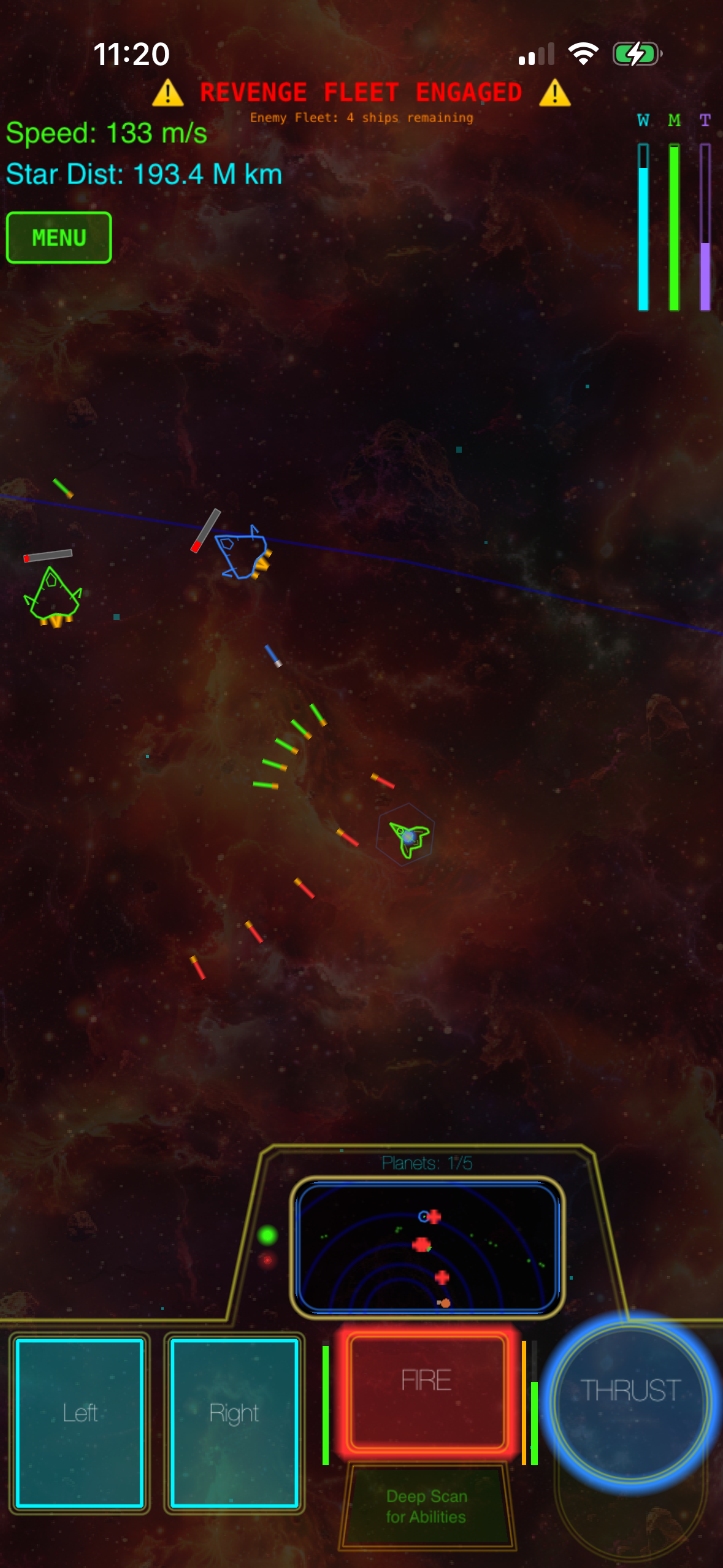
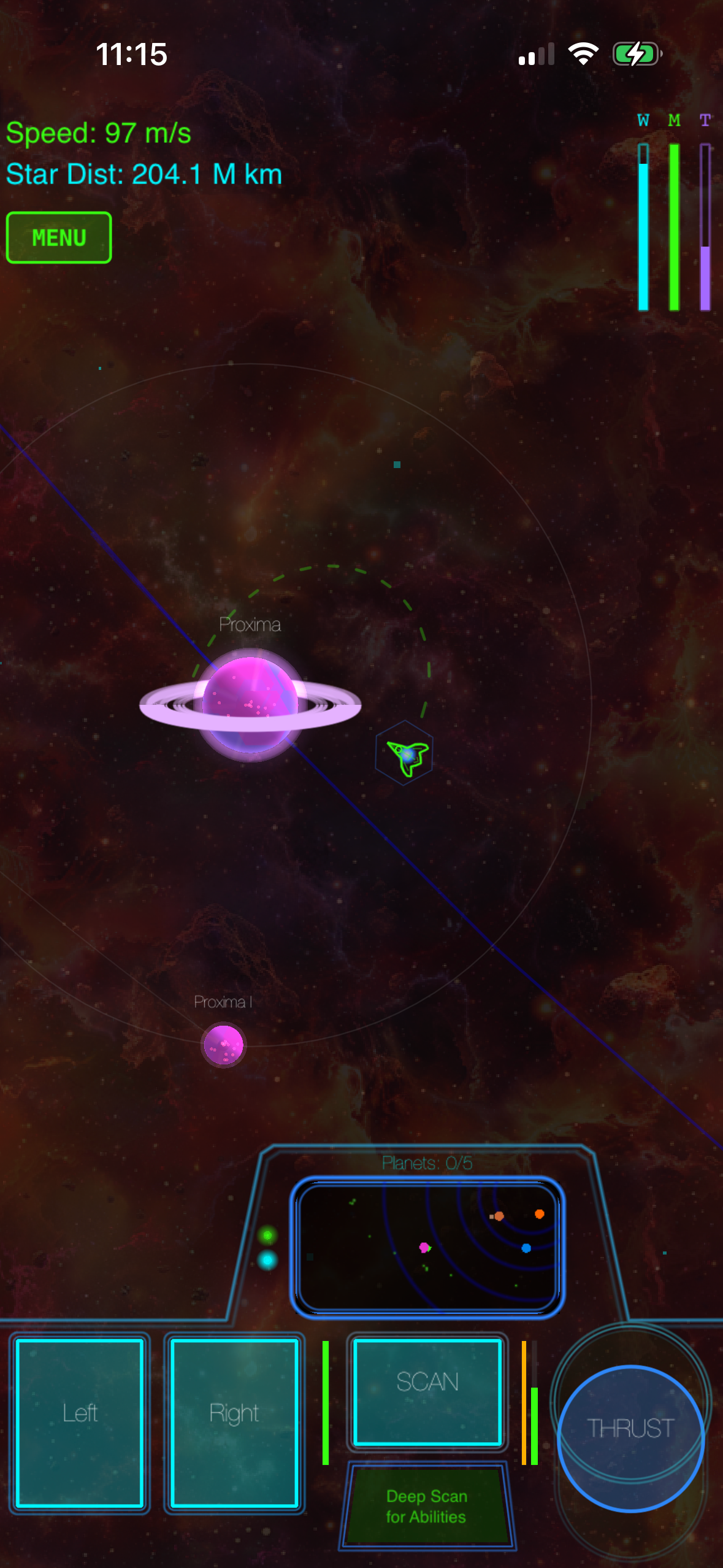
Real orbital mechanics matter here. Galaximus models n-body gravity in real time — planets orbit suns, moons orbit planets, and your ship responds to all gravitational forces simultaneously. Most competitors use simplified Newtonian approximations or arcade-faked gravity for accessibility. In Galaximus, you learn to use gravity as your engine. Slingshots around planets become your fuel budget. That’s a fundamentally different kind of mastery than twitch reflexes.
The other marker is completion. Premium space games ship with a beginning, middle, and end. Not a soft-launched sandbox you’re waiting two years for content on. Not a tutorial masquerading as a game. A full campaign you can finish, then replay because procedural generation means no two playthroughs are identical.
Galaximus: Real Gravity, Real Mastery
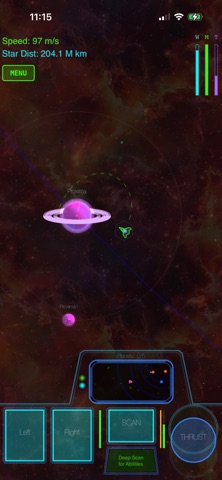
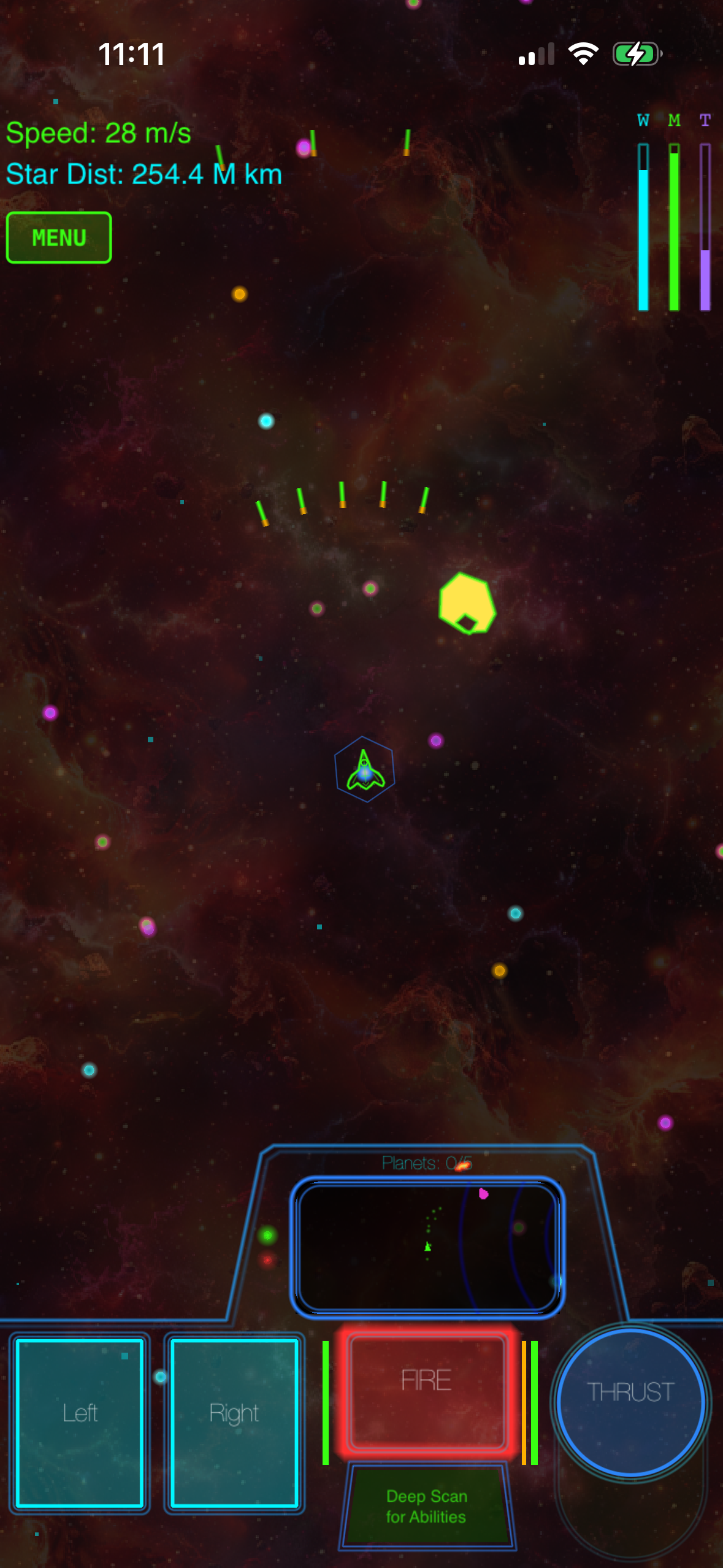
Galaximus is the standout here. Every celestial body obeys actual orbital mechanics — planets orbit suns, moons orbit planets, asteroids tumble through gravity wells, and your ship responds to all of it in real time. The control scheme is counterintuitive at first; you’re not pushing the ship forward like a spaceship game from the 1980s. You’re managing thrust and angle to use gravity as your engine. A 30-minute learning curve pays off for hours.
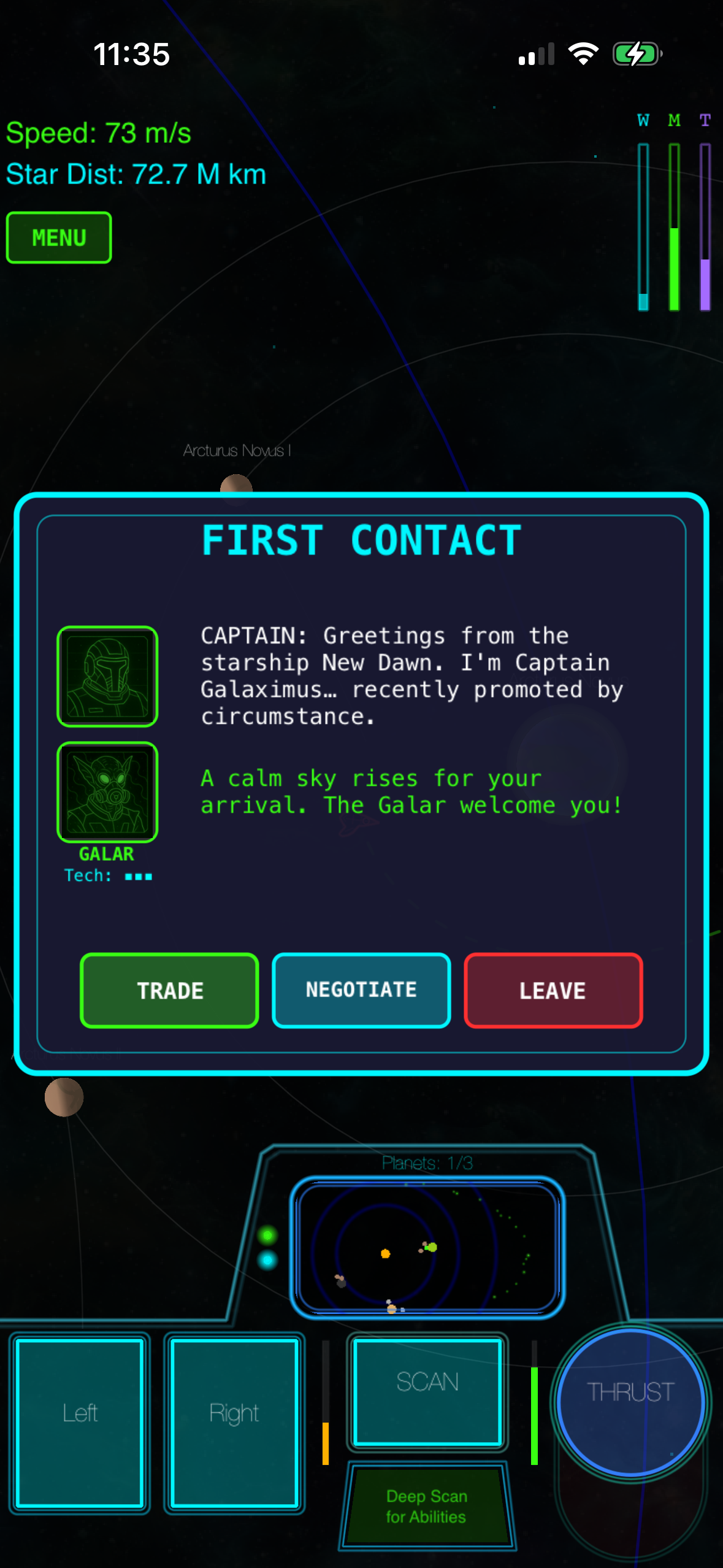
The campaign spans eight star systems, each with 3–5 procedurally configured mission variants. You’ll encounter anomalies — spacetime rifts, derelict ships, distress beacons, alien first contacts — each one a self-contained mini-experience. Combat is real-time, tactical, and punishing if you waste fuel. The procedural audio synthesis (every sound generated in real time, no pre-recorded files) reinforces the arcade-vector aesthetic without feeling cheap. Campaign completion takes 12–18 hours; additional playthroughs vary based on procedural generation.
The developer shipped The Last of Us Part II at Naughty Dog before going solo. That pedigree shows in the polish-per-feature ratio. This is a one-time purchase at — buy now and the upcoming Galaximus Infinitum expansion (open-galaxy sandbox, planetary surface exploration, outpost building, launching late 2026) comes free when it ships. After Infinitum launches, the combined game moves to. Early adopters get the expansion at no extra cost.
Get Galaximus on the App Store:
Asteroids: Recharged — Arcade Lineage Done Right
This is vector-arcade heritage executed with craft. Asteroids: Recharged respects the 1979 original — you’re still shooting rocks in a 2D field — but layers in modern arcade sensibilities. The visuals are neon and clean. The difficulty ramps with intention. Power-ups are sparse enough that you’re never coasting on free resources.
It’s not a space-exploration game; it’s a survival game where space is the arena. That distinction matters. You get waves, escalating challenge, and the satisfaction of a high-score chase. No narrative, no story beats — just you, asteroids, and the question of how long you can last.
One-time purchase at. No ads between waves. No energy timer. No “come back tomorrow” gates. That’s rarer than it should be for a game this polished.
Lunar Rescue — Gravity as Puzzle
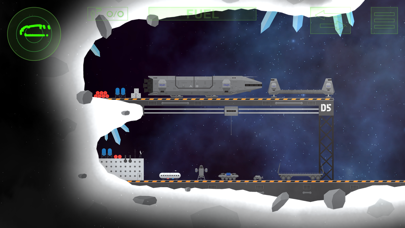
Lunar Rescue takes the Lunar Lander lineage and makes it a puzzle game. You’re landing a spacecraft on the moon, and fuel is finite. The gravity is real (not arcade-faked), so you have to account for the moon’s pull. The challenge isn’t reflexes; it’s planning. Can you reach the landing zone without burning all your fuel on descent correction?
Each level is a small puzzle. The learning curve is gentler than Galaximus, but the mastery is real. This is the game you play when you want to think more than react. one-time purchase.
Among the Stars — Deck-Building in Space
Among the Stars is a space-themed deck-building game, not an action game. You’re building a space station, card by card, managing resources and factions across multiple rounds. It’s cerebral, turn-based, and deep — the kind of game that rewards planning three moves ahead.
If you want space-game atmosphere without arcade action, this delivers. The production is solid, the mechanics are clean, and there’s genuine strategic depth. one-time purchase.
Exploring the Genre: What These Games Share
All of these are complete. None of them are waiting for a content update to justify their existence. All of them respect your time — they don’t demand daily logins or seasonal battle passes. All of them work offline.
The split is interesting: Galaximus and Lunar Rescue emphasize real physics. Asteroids: Recharged is pure arcade reflex. Among the Stars is brain-over-twitch. That variety means there’s something for different moods.
If you’re coming from free-to-play space games, the first shock is the learning curve. Premium games on iPhone don’t hold your hand as much. They expect you to read the tutorial, fail a few times, and then click. That’s a feature, not a bug — it’s why they’re worth paying for.
Technical Requirements
Galaximus: Requires iOS 15.0+, 2GB free storage, works on iPhone 11 and later.
Asteroids: Recharged: Requires iOS 14.0+, 500MB free storage, works on iPhone XS and later.
Lunar Rescue: Requires iOS 14.0+, 800MB free storage, works on iPhone XS and later.
Among the Stars: Requires iOS 15.0+, 1.2GB free storage, works on iPhone 12 and later.
All games support offline play on compatible devices.
What to Expect in Your First Hour
Asteroids: Recharged: You’ll understand the controls in two minutes. You’ll hit a wall around wave five and realize the difficulty is real. That’s the hook — it’s simple to learn, hard to master, and you keep trying because there’s no energy timer stopping you. First hour: 5–8 waves, high-score chasing.
Galaximus: You’ll complete the tutorial (5 minutes), attempt your first gravity slingshot (10 minutes), and hit your first fuel-management failure (15 minutes). By 30 minutes, you’ll understand why the physics matters. By one hour, you’ll have completed the first system and unlocked real tactical depth.
Lunar Rescue: You’ll solve 4–6 landing puzzles, each one introducing a new gravity or fuel constraint. No time pressure. You can restart as many times as you need. First hour: puzzle mastery, not action.
Among the Stars: You’ll play 2–3 full rounds of station building, learning card synergies and resource management. Turn-based means no time pressure. First hour: strategic foundation, deck-building fundamentals.
FAQ
Do any of these games require an internet connection?
No. All of them work offline. That’s a core part of the premium model — you own the game outright, and it doesn’t phone home for validation or ads.
Which one has the steepest learning curve?
Galaximus. The orbital mechanics are real, and the control scheme takes practice. But that’s also why the mastery is satisfying. If you’re willing to invest 30 minutes, you’ll unlock a fundamentally different kind of space game than the ones that fake gravity for accessibility.
Can I play these games casually, or do they demand long sessions?
All of them support short play sessions. Asteroids: Recharged is designed for 5-minute runs. Lunar Rescue is level-based, so you can stop after one or two. Galaximus has natural stopping points between systems. Among the Stars is turn-based, so there’s no time pressure.
Are there multiplayer or competitive modes?
No. These are all single-player experiences. That keeps the focus on craft and design rather than matchmaking and server costs.
The Bottom Line
Premium space games on iPhone exist in a narrow band. They’re not trying to be No Man’s Sky or Elite Dangerous. They’re games where the iPhone’s constraints became design decisions — where touch controls and small screens forced developers to think about what space games actually need to be satisfying.
If you’re tired of free-to-play energy timers and battle passes, these games are the antidote. They’re complete, they’re craft-built, and they respect your time.
Pick one that matches your mood. Real physics and tactical depth point toward Galaximus. Pure arcade reflex points toward Asteroids: Recharged. Puzzle-solving points toward Lunar Rescue. Strategic thinking points toward Among the Stars.
The space is small, but it’s worth exploring.