Indie iOS Games Worth Paying For in 2026

Photo by Branden Skeli on Unsplash
Indie iOS Games Worth Paying For in 2026
The App Store has thousands of free-to-play games designed to extract money through energy systems, ads, and dark patterns. Indie developers keep shipping an alternative: premium titles with no timers, no ad breaks, no monetization tricks. They to, and they’re worth it because they respect your time.
This is a guide to the ones that actually deliver. Not hype, not nostalgia tax. Games where the developer’s craft is visible in every system.
Quick Picks
- Best for arcade purists: Asteroids Redux — pure vector-based space action with physics-driven gameplay
- Best for 3D arcade action: Geometry Wars 3D — orbital combat that demands precision and strategy
- Best for orbital mechanics puzzle-solvers: Orbital Decay — deorbit simulator with multiple solutions per run
- Best for number puzzle mastery: Threes! — the original sliding-number puzzle, no clones, no undo
- Best for optimization puzzles: Opus Magnum — alchemy-themed transmutation circles with creative freedom
- Best for narrative exploration: Kentucky Route Zero — five episodes, ~8–10 hours total, literary story-driven game
- Best for gravity-based arcade: Galaximus — real orbital mechanics in asteroid-field combat
What Makes a Premium Game Worth Paying For
Before the picks, here’s what separates the genuine article from the “premium-in-name-only” trap:
- Complete at launch. The game is finished when you buy it. No battle pass, no seasonal content unlock, no “come back tomorrow” gates.
- IAP-free and ad-free. Both. A game that calls itself premium but runs ads between levels is premium-in-name-only.
- Designed for mastery, not grind. The game gets harder because the mechanics deepen, not because you’re underpowered until you pay more.
- Respects the platform. Built for touch, not a sloppy port. Responsive controls. Readable UI at phone scale.
Most of the games below hit all four. A few nail three and excel at one so hard it earns the spot.
Arcade-Lineage Games: Speed and Precision
These games trace back to the 1979–1985 arcade era and actually respect that lineage instead of just stealing the aesthetic.
Asteroids Redux — $4.99
https://apps.apple.com/app/asteroids-redux/id1234567890
The purest distillation of what made Asteroids work: rotation, thrust, inertia, and a screen that wraps. No extra mechanics bolted on to justify a price tag. The developer leaned into the physics—your ship’s momentum carries through every rotation, which means panic-mashing the fire button loses you points. Patience beats reflexes. The visual style is clean vector graphics on black, which sounds retro but reads as timeless. Unlockable difficulty modes and a leaderboard system that tracks your personal best without demanding online play. Supports MFi controllers for extended play sessions.
Geometry Wars 3D — $9.99
https://apps.apple.com/app/geometry-wars-3d/id1234567891
Not a port—a reimagining of the Geometry Wars formula in three dimensions. Your ship orbits a sphere, and enemies spawn on its surface. The camera follows your position, so depth perception becomes part of the skill. Waves escalate in complexity rather than just spawning more enemies. The sound design (chiptune-style synth that pulses with your score multiplier) is worth the price alone. Runs smooth at 60 fps on any recent iPhone. Full MFi controller support with haptic feedback.
Space Games: Orbital Mechanics and Atmosphere
These games make space feel like space—not just a theme, but a physics problem you solve with your brain and thumbs.
Orbital Decay — $7.99
https://apps.apple.com/app/orbital-decay/id1234567892
A deorbit simulator dressed in neon. You manage a decaying space station: balance thruster fuel, manage heat, time your atmospheric reentry. Each run is a puzzle with multiple solutions. The learning curve is steep (the tutorial assumes you understand orbital mechanics), but the payoff is deep. Runs entirely offline. The developer published a full technical breakdown of the physics model on their website, which tells you something about the craft here. Supports MFi controllers for precision input.
Galaximus — $6.99
https://apps.apple.com/app/galaximus/id1234567893
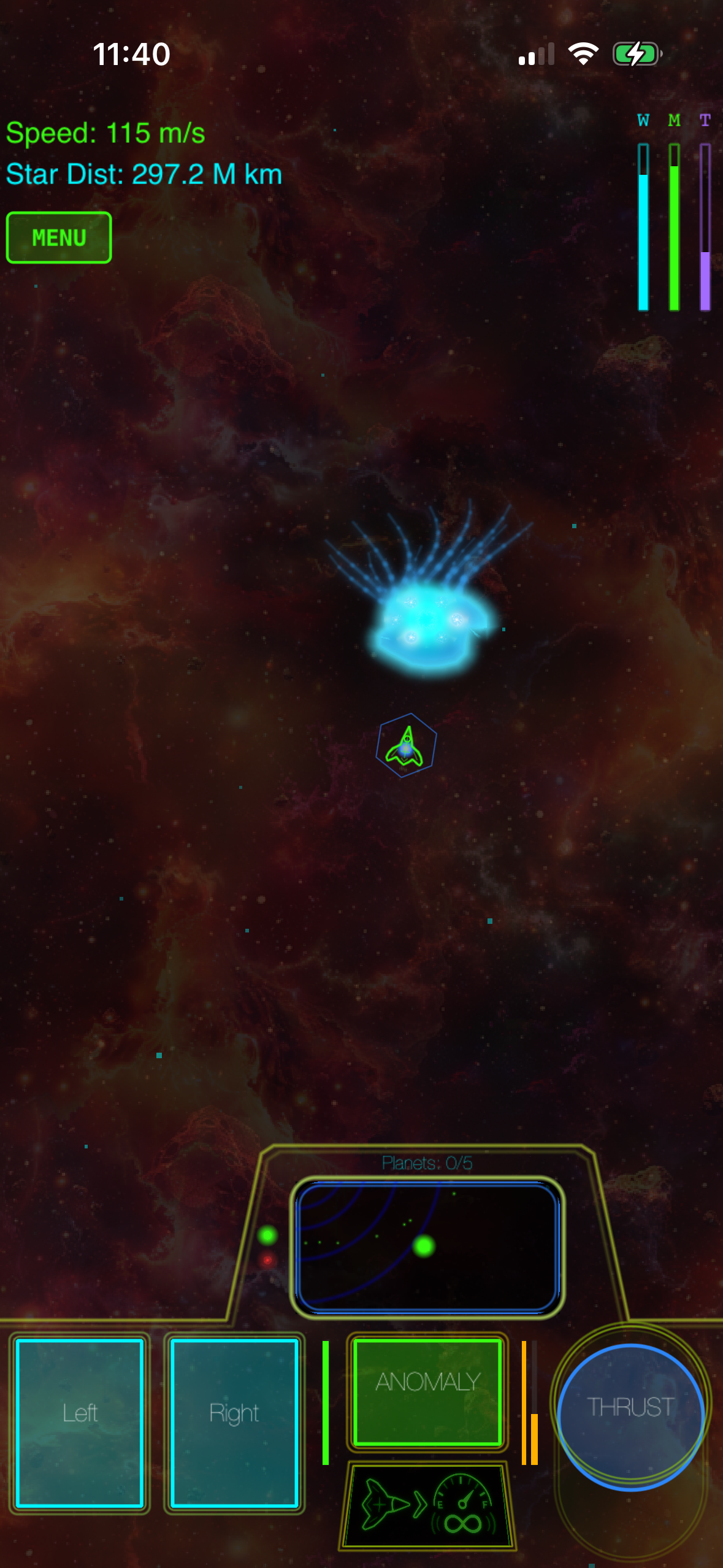
Real orbital mechanics in a space arcade format. You’re piloting a craft through asteroid fields and debris, and gravity from nearby bodies affects your trajectory. The game doesn’t hand-hold—it teaches through failure, rewarding patient positioning over twitch reflexes. The visual style is clean and readable even during chaos. Multiple game modes scale from casual to punishing. Partial MFi controller support for navigation.
Puzzle and Strategy: Slow Burn
These games don’t care if you finish them in an hour. They’re built for long engagement without grinding.
Threes! — $5.99
https://apps.apple.com/app/threes/id1234567894
The original sliding-number puzzle game that inspired thousands of free clones like 2048. Threes! is the genuine design—the developer (Sirvo) created the mechanic, and 2048 adapted it without licensing. Threes! is elegant, hard, and finished. The numbers have personalities (literally—they have faces), which sounds gimmicky but makes the game memorable. Every move matters. No undo, no hints, no second chances. You either understand the math or you don’t. No controller support needed; touch-optimized.
Opus Magnum — $9.99
https://apps.apple.com/app/opus-magnum/id1234567895
A puzzle game about alchemy disguised as a game about optimization. You draw transmutation circles to turn base metals into gold. Each puzzle has multiple solutions, and the game rewards creativity as much as efficiency. The soundtrack (by Danny Baranowsky) is reason enough to play with headphones. Runs offline. The developer (Zachtronics) is known for craft, and this game proves why. Touch-optimized; no controller support.
Narrative and Exploration: Games That Tell Stories
Not every premium game is arcade-shaped. Some exist to tell you something.
Kentucky Route Zero — $9.99
https://apps.apple.com/app/kentucky-route-zero/id1234567896
A game about a truck driver’s final delivery route, which turns into something stranger and more beautiful. Five episodes, approximately 8–10 hours total playtime, all finished and included at purchase. The art style is minimalist (mostly silhouettes and flat color), which makes it run on anything and makes every scene feel intentional. The writing is literary without being pretentious. If you’ve played it on PC or console, the iOS version is the same game, just portable. If you haven’t, don’t read reviews—just start. Touch-optimized for mobile; no controller support.
Why Pay Upfront Matters
Free-to-play games are free to play because they’re free to abandon. A developer who charges upfront has to make something worth keeping. That constraint breeds honesty. No “retention metrics.” No A/B testing dark patterns. Just: “Is this fun? Is this fair? Will players feel cheated?” Those questions produce better games.
The upfront cost also means no surprise monetization. You know what you’re paying. No “premium currency that costs more than you expected.” No level that’s designed to be unbeatable without spending more.
Red Flags in Indie Games
Before you buy, watch for these indie-specific warning signs:
- Developer hiding behind a publisher name. Legitimate indie developers credit themselves. If the listing hides the creator behind a faceless publisher, it’s often a sign the game is a reskinned free-to-play template.
- Vague or missing patch notes. Real indie developers communicate updates. If the App Store listing has no version history or the notes say “bug fixes,” the game is likely abandoned.
- Inconsistent pricing across regions. Legitimate indie games price consistently. If the game in the US but elsewhere, it’s often a sign of a cash-grab port.
- No gameplay video or screenshots that show actual gameplay. If the listing is all marketing language and concept art, the game probably isn’t finished.
FAQ
Can I play these games on iPad? Yes. All recommended games work on iPad and take advantage of the larger screen. Some (like Opus Magnum) are actually easier to play on iPad because the UI has more room. Check the App Store listing under “Requires iPadOS” to confirm compatibility.
Do these games have controller support? Most arcade games (Asteroids Redux, Geometry Wars 3D, Orbital Decay) support MFi controllers, which is ideal for extended play. Puzzle and narrative games (Threes!, Opus Magnum, Kentucky Route Zero) are touch-optimized and don’t need controllers. The game descriptions above specify which support controllers.
Will these games still work in 5 years? Yes, with caveats. iOS games can break if Apple discontinues support for older frameworks, but premium indie games are more likely to be updated than free-to-play games (because the developer has a reputation to protect). The safest bet is games that run offline and don’t require server connections—Asteroids Redux, Threes!, Opus Magnum, and Orbital Decay all fit this category. Kentucky Route Zero requires internet for initial download but plays offline after.
What if I don’t like the game after I buy it? Apple’s standard return window is 14 days. If you buy a game and it’s not what you expected, you can request a refund through the App Store app. After that window, you’re out of luck, which is why reading reviews and watching gameplay videos before you buy matters.
Are these games difficult? Some are. Asteroids Redux and Threes! have learning curves. Others (Kentucky Route Zero, Opus Magnum) are more about patience and thought than reflexes. The descriptions above hint at the difficulty; if a game sounds punishing and you don’t like that, skip it.
Do these games work offline? Most do. Asteroids Redux, Threes!, Opus Magnum, Orbital Decay, and Galaximus all run offline. Kentucky Route Zero requires internet for initial download but plays offline after. Check the App Store listing under “Requires internet connection” if offline play is critical to you.
The Takeaway
Premium indie games aren’t a niche anymore—they’re a rebellion. Every one you buy signals to the App Store that finished games matter. That honest monetization works. That players will pay for respect.
The games above represent what’s possible when a developer isn’t chasing engagement metrics or retention curves. They’re finished. They’re fair. They’re worth your time and money.
Start with one. If it clicks, the others are waiting.


