iPhone Games for Adults No Microtransactions: Premium Selection

Photo by Onur Binay on Unsplash
iPhone Games for Adults No Microtransactions: The Premium Selection for 2026
Adult iPhone gamers have a problem: the App Store is drowning in free-to-play games designed to extract money through battle passes, energy timers, and cosmetic pressure. Finding a complete, craft-built game you buy once and own forever is harder than it should be. This guide rounds up five premium titles—no ads, no IAP, no subscriptions—that prove the best mobile gaming still happens when developers aren’t beholden to engagement metrics and monetization funnels.
Why Premium Games Matter for Adult Players
The free-to-play model optimizes for session length and repeat monetization, not for player satisfaction. A game designed to be “complete” the moment you buy it operates under different pressure: it has to be good enough to justify the upfront cost, and it has to stay good across dozens of hours without artificial gates.
Adult gamers tend to have less time but higher craft expectations. You’re not grinding for the sake of grinding. You’re not waiting for energy to regenerate. You’re not watching ads to unlock a feature that should’ve been in the base game. You’re playing because the mechanics are tight, the visuals are intentional, or the story earns your attention.
The games listed here share a trait: they were built by developers who prioritized the experience over the monetization model. That’s not virtue-signaling—it’s a structural difference that affects everything from difficulty curve to visual polish to how the game ends.
Asteroids: Recharged
Price: | No IAP
Recharged takes the 1979 arcade vector classic and rebuilds it for modern iPhone hardware without abandoning what made the original work: momentum-based flight, deliberate aim, and the tension between aggression and survival.
The core loop is familiar—rotate, thrust, shoot, dodge—but the execution respects the physics. Your ship doesn’t snap to aim; it drifts with inertia, and skilled players learn to position themselves before firing, not fire and hope. Asteroids fragment into smaller rocks, and the pattern matters: you can’t just spray bullets. You have to think two moves ahead.
The pixel-art refresh (rather than pure vector) gives the game visual warmth while keeping the silhouette clarity that made the original readable. Power-ups exist but don’t dominate the strategy; they’re bonuses, not crutches. The difficulty curve is steep but fair—there’s no rubber-banding, no “the game gets easier when you’re losing” catch-up mechanics. You either learned the controls or you didn’t.
Into the Breach
Price: | No IAP | Updated regularly through 2025
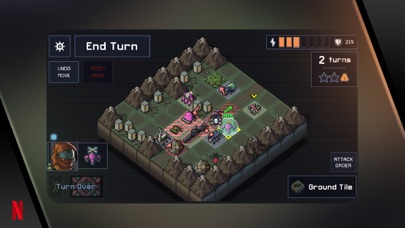
Into the Breach is a turn-based tactics game where every unit on the board—yours and the enemy’s—has a visible action queue. You see what the enemy will do before you move. This flips the usual tactics formula: the game isn’t about reacting faster; it’s about reading the board and planning the perfect sequence.
The hook is elegant: you can’t out-damage your opponents, so you have to out-think them. Knock an enemy into lava. Push a missile back toward its launcher. Position your mech so the enemy’s attack hits their own ally. The game rewards lateral thinking and punishes hesitation, but never randomness—a loss is always your mistake, never the dice.
Each run is a campaign of island-based battles with escalating difficulty. The game ships with multiple mech squads (each with different abilities), so the strategic space is genuinely large. A run takes 30-45 minutes, making it perfect for adult players with fragmented gaming time. The developer has released balance updates and new squad variants through 2025, extending replayability.
The pixel-art aesthetic is clean and readable, critical for a tactics game where information density matters. There’s no fluff, no tutorial padding. The game trusts you to learn by playing.
Galileo

Price: | No IAP
Galileo is a slow-burn orbital mechanics game paired with hand-drawn astronomy. You’re placed in a solar system (real or fictional) and given tools to plot trajectories, calculate orbital periods, and explore.
The game doesn’t rush you. There’s no timer, no “complete this in X seconds” pressure. You can spend an hour plotting a single Hohmann transfer, or you can skip the math and just experiment with gravity wells. The hand-drawn planets and moons have personality—they’re not procedural, they’re illustrated—and the game rewards curiosity by hiding details that only appear when you get close.
The learning curve is gentle but real. Early scenarios teach you how gravity works through play rather than exposition. By the time you’re tackling multi-body problems, you’ve internalized the physics intuitively. It’s the kind of game that makes a player feel like they’re learning something, not grinding toward a reward.
Galileo is meditative rather than intense, which is its strength. It’s the game you play when you want to think, not when you want adrenaline.
Kentucky Route Zero: TV Edition
Price: | No IAP
Kentucky Route Zero is a narrative adventure game that defies easy categorization. It’s a magical-realism road story about a truck driver making his final delivery before retirement. It’s episodic, deliberately paced, and visually sparse—mostly dialogue, music, and minimalist pixel art.
The TV Edition bundles all five episodes into a single narrative arc optimized for mobile play. Scenes are short, dialogue is weighted, and the story trusts the player to sit with ambiguity. There’s no combat, no fail states, no progression meters. You’re reading a story that happens to be interactive.
For adult players, this is the appeal: the game respects your intelligence and your time. It doesn’t pad scenes with busywork. The writing is literary—characters have depth, conversations have subtext, and the ending lands because it’s earned, not because the game told you to feel something.
The game is melancholic and occasionally strange, which limits its audience by design. But for the players it connects with, it’s the kind of experience that lingers for months.
Geometry Wars 3: Dimensions
Price: | No IAP
Geometry Wars 3 is a neon-grid arcade shooter that extends the twin-stick formula into three dimensions without losing the arcade lineage. You’re a glowing shape firing at waves of geometric enemies on a grid, and the goal is to rack up the highest score before you’re overwhelmed.
The game is pure arcade: tight controls, immediate feedback, and a difficulty curve that respects skill. There’s no story, no progression system that unlocks content—every mode is available from the start. You’re playing for the score, for the personal best, for the moment when you’re in flow and the controls feel like an extension of your hands.
The visual design is intentional. The neon aesthetic isn’t nostalgia-bait; it’s a functional choice that makes enemies readable against the grid. The particle effects are dense without being chaotic. The sound design (bleeps, boops, and a pulsing synth track) reinforces the arcade fantasy without becoming annoying.
How to Spot Genuine Premium Games
Not every game labeled “premium” on the App Store actually is. Here’s what to look for:
One-time purchase, no IAP. Check the App Store listing. If it says “Offers In-App Purchases,” it’s not premium—with rare exceptions like cosmetic-only purchases that don’t affect gameplay (e.g., alternate skins). Most genuine premium games avoid IAP entirely. Same for “Contains Ads.” A genuinely premium game charges once at install and never asks for more money.
No energy timers or battle passes. If the game gates progression behind a “wait 8 hours or pay” timer, it’s free-to-play dressed up as premium. Same for seasonal battle passes or cosmetics that affect gameplay.
The game has an ending. Free-to-play games are designed to be endless (or at least, endlessly monetizable). Premium games have a narrative arc, a skill ceiling, or a designed endpoint. You can finish it.
Reviews mention completion. Read player reviews on the App Store. If people are talking about beating the game, finishing the story, or hitting a skill plateau, that’s a signal of genuine premium design. If reviews are dominated by “the grind is real” or “pay to win,” skip it.
Premium vs. Free-to-Play: The Real Tradeoff
Premium games cost more upfront but don’t ask for ongoing money. Free-to-play games are free to download but often cost significantly more over time through cosmetics, battle passes, or gameplay conveniences. A player who spends on cosmetics in a free-to-play game has paid more than the entire premium selection listed here.
That said, some players prefer free-to-play with optional cosmetics—they enjoy the social element, seasonal content, or the ability to try before committing money. Premium games don’t offer that flexibility. You’re buying the full experience sight unseen. For adult players with limited time and clear preferences (arcade games, tactics, narrative), premium games eliminate the monetization friction. For players who want ongoing updates and seasonal events, free-to-play may still be the better fit.
FAQ
Can I refund a premium game if I don’t like it?
Apple allows refunds within 14 days of purchase if you haven’t used the app significantly. Contact App Store support with your reason. After 14 days, refunds are at Apple’s discretion. Read reviews carefully before buying to minimize this risk.
Do these games work on iPad?
Yes. All five titles are universal apps optimized for iPhone and iPad. Larger screens make games like Into the Breach and Geometry Wars 3 more readable. Check individual App Store listings for specific iPad compatibility details.
Can I play these games offline?
Asteroids: Recharged, Into the Breach, Galileo, and Geometry Wars 3 work fully offline. Kentucky Route Zero requires an initial download but plays offline after that. No internet needed once installed.
Do premium games get updated?
Yes, but inconsistently. Into the Breach received balance updates and new squads through 2025. Asteroids: Recharged is feature-complete as-is. Geometry Wars 3 receives occasional patches. Kentucky Route Zero is finished (all episodes released). Check the “Version History” section on each App Store listing to see recent update patterns.
Why are these games more expensive than free-to-play alternatives?
Because they’re complete. A free-to-play game might cost nothing to download but hundreds of dollars over time if you engage with cosmetics or battle passes. A premium game costs upfront and nothing after. You’re not paying for the download; you’re paying for the entire game without monetization pressure.
Where do I find more games like these?
Look for games labeled “Paid” (not “Free” or “Free with In-App Purchases”) on the App Store. Filter by Games > Categories > Arcade, Strategy, or Adventure. Read reviews mentioning “no IAP,” “complete experience,” or “worth the price.” Check indie game sites like Metacritic or TouchArcade for curated lists of premium titles.
The Bottom Line
The premium iPhone game space is smaller than the free-to-play deluge, but it’s where the craft lives. Developers building games without monetization pressure can afford to prioritize what matters: tight controls, thoughtful difficulty curves, intentional visuals, and experiences that respect the player’s time.
If you’re an adult gamer tired of energy timers and battle passes, these five titles represent the best of what’s possible when a developer commits to one-time purchase and walks away from the engagement-metric treadmill. They’re not free, but they’re complete—and for players who value craft over convenience, that’s worth every penny.


