iPhone Games Like Pac-Man: Modern Maze Arcade Reimagined

Photo by Mika Baumeister on Unsplash
iPhone Games Like Pac-Man: Maze Strategy Reimagined
If you’re hunting for iPhone games that capture what made Pac-Man timeless—the tension of navigating a maze while something hunts you, the rhythm of risk-and-reward routing, the satisfying click of eating dots—you won’t find a straight port on the App Store. What you will find are craft-built games that respect the lineage and push the formula forward. This guide walks you through the best modern alternatives, each one solving the maze-chase problem in a different way.
Why Pac-Man’s Formula Still Works in 2026
Pac-Man succeeded because it solved a design problem: how do you make a game where being chased is fun rather than just stressful? The answer was ghost AI. The four ghosts—Blinky, Pinky, Inky, and Sue—each had distinct patrol and hunting logic. They weren’t random; they were predictable enough that a skilled player could learn their patterns and thread the needle. That asymmetry—you’re faster in short bursts, but they’re relentless and coordinated—created a gameplay loop that still feels alive.
Modern maze-chase games on iPhone either replicate that tension directly or borrow the structure of the formula (navigable space, collectibles, pursuers) and remix it. Both approaches work. The key is whether the game respects the original’s pacing: moments of breathing room, moments of genuine danger, and a learning curve steep enough that mastery feels earned.
Games That Lean Into Ghost AI and Pursuit
Theseus

** one-time purchase**
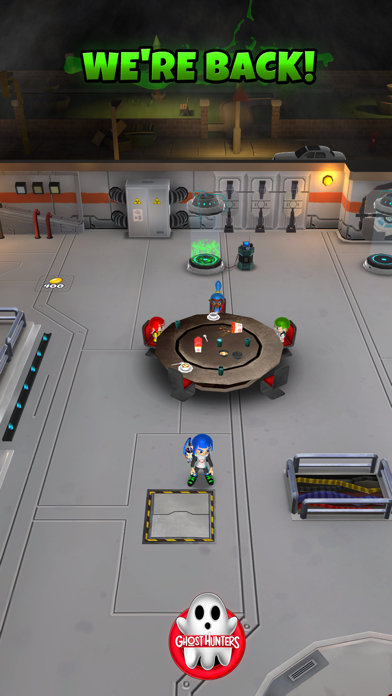
Theseus inverts the Pac-Man setup: you’re the Minotaur in a procedurally generated labyrinth, and the hunter is a player-controlled Theseus with a thread that unwinds as he moves. Your job is to hunt him before he escapes. It’s asymmetrical—Theseus moves slower but can’t be cornered the same way Pac-Man can, because his thread marks his path. The maze shifts between rounds, forcing you to relearn routing with each play.
Typical match lasts 3–5 minutes. Supports 1–2 players (pass-and-play or single-player vs. AI). Win condition: catch Theseus before he reaches the exit, or escape as Theseus without being caught.
What makes it sing: the AI opponent (or human opponent, if you play pass-and-play) has to think about the maze, not just charge. You can’t just memorize a ghost’s behavior; you have to read the geometry and predict where your opponent will route. It’s Pac-Man’s tension reframed as a strategic duel.
Pac-Man Party Royale
** one-time purchase (free version with ads available)**
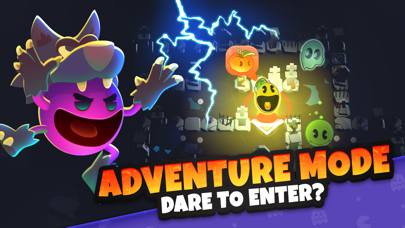
This is the official modern Pac-Man, and it’s not a straight port. It layers multiplayer modes (up to four players on one device or online) onto the classic maze-chase formula. The ghost AI is faithful to the original—Blinky charges, Pinky tries to ambush ahead, Inky uses triangulation—but the multiplayer framing means you’re competing for dots and power-ups against other players while the ghosts hunt everyone. It’s chaos in the best way.
Typical match lasts 10–15 minutes per round. Supports 1–4 players locally or online. Win condition: collect the most dots and survive the ghost waves, or outlast opponents in competitive modes.
The game respects the original’s pacing. Dots are sparse enough that routing matters; power-ups feel earned. It’s not trying to reinvent the wheel; it’s just making the wheel multiplayer-capable and tuning the difficulty curve for modern players who expect more feedback.
Games That Remix the Formula
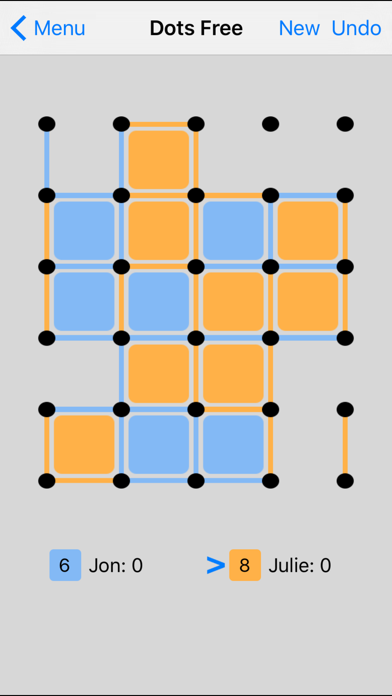
Dots & Co
** one-time purchase**
Dots & Co sounds like a match-three game—and mechanically, it is—but the level design forces maze-like thinking. You’re collecting dots of the same color, and the board layout means you have to route through the space strategically. Power-ups (bombs, cascades, multipliers) reward routing efficiency, not just random matches. The aesthetic is pure vector minimalism: dots on a grid, clean lines, no clutter.
It’s not a chase game, so it loses Pac-Man’s tension. But it keeps the rhythm—the feeling of navigating a constrained space with limited moves and learning the optimal path through trial and error.
Ms. Pac-Man
** one-time purchase**
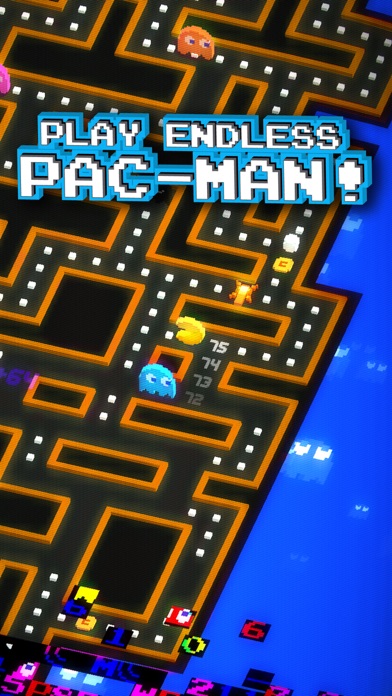
The official port of the 1982 arcade sequel. Ms. Pac-Man is subtly different from the original: the mazes are more complex, the ghost AI is slightly more aggressive, and the fruit placement is randomized. If you want the actual Pac-Man experience with ghost behavior that’s authentic to the arcade, this is it.
The catch: it’s a straight port. No modern conveniences, no new mechanics. If you want to understand why Pac-Man works—the ghost patterns, the dot routing, the power-up timing—this is the textbook. But if you’re looking for something that feels like Pac-Man but isn’t literally Pac-Man, you’ll want to look elsewhere.
Modern Indie Takes on the Maze-Chase
Maze Craze
** one-time purchase**
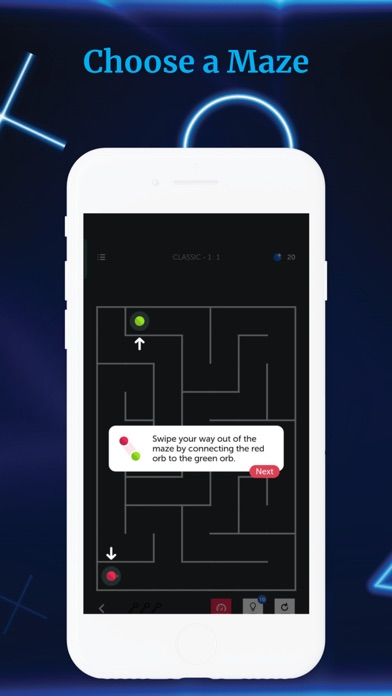
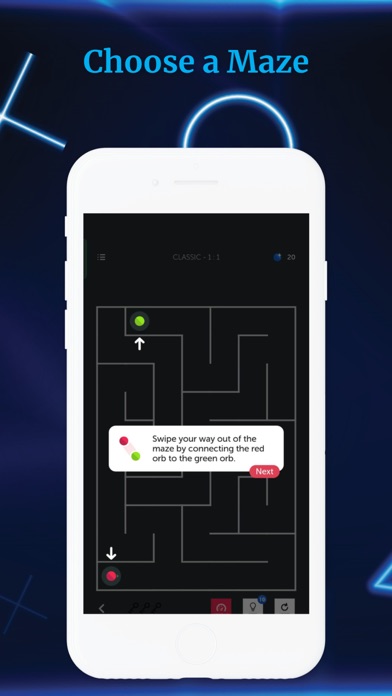
Maze Craze generates a new maze each round and drops you in with three ghosts on your tail. The twist: you can place temporary walls as you move (costs one energy per wall, max 5 walls per round, regenerates energy every 3 seconds). It’s real-time, so you can’t pause to think; you have to route and wall-place simultaneously. Power-ups (speed boost, ghost stun, wall-building spree) appear at fixed points, rewarding players who memorize their locations. Wall-placement is a core mechanic, not a power-up—it’s available from the start of each match.
Typical match lasts 5–10 minutes. Single-player only. Win condition: survive all ghost waves and collect a target number of dots.
The game nails the feeling of Pac-Man—that sense of threading a needle between pursuers—while adding enough mechanical depth that replays don’t feel identical. Procedural generation means you can’t memorize a single optimal path; you have to read the maze as it appears.
Gridrunner
** one-time purchase**
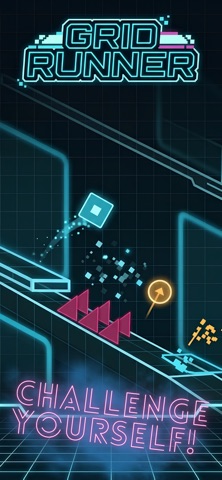
Gridrunner is a spiritual successor to Pac-Man filtered through arcade-era vector graphics aesthetics (clean lines, pulsing colors, synthesizer soundtrack). You navigate a grid while enemies chase you and you collect pickups. The grid wraps around edges, so you can escape off-screen and reappear on the opposite side—a mechanic that adds routing depth.
Typical match lasts 3–7 minutes. Single-player only. Win condition: survive enemy waves and reach target score.
It’s faster and more frenetic than Pac-Man, and the enemy patterns are less predictable, so it’s more about reflex than learning. But if you want that “hunted in a confined space” feeling with a modern arcade sheen, Gridrunner delivers.
FAQ
Do these games support MFi controllers?
Pac-Man Party Royale, Ms. Pac-Man, and Gridrunner all support MFi controllers. Theseus and Maze Craze are touch-only. If controller support matters to you, stick with the first three.
Which runs best on iPhone SE?
All of them run smoothly on iPhone SE (2nd gen and newer). Ms. Pac-Man and Dots & Co are the least demanding. Maze Craze and Gridrunner require slightly more processing power but still perform well on older hardware.
Can I play offline?
All of them. They’re all single-player or local-multiplayer experiences that don’t require a network connection. Pac-Man Party Royale has an online multiplayer mode, but the single-player campaign and local modes work offline.
Do any of these have in-app purchases or ads?
The games listed here are premium-tier (one-time purchase, no ads, no IAP). Pac-Man Party Royale also has a free version with ads and energy timers; the paid unlock removes both. The indie alternatives (Theseus, Maze Craze, Gridrunner, Dots & Co) are all premium, no surprises.
How do ghost patterns in these games compare to the original?
Ms. Pac-Man and Pac-Man Party Royale use authentic ghost AI from the arcade. Theseus and Maze Craze use simpler, more predictable AI because the games are designed around different mechanics (asymmetry and wall-placement, respectively). Gridrunner’s enemies are faster and less pattern-based, so they feel more like obstacles than hunting partners.
Wrapping Up
If you loved Pac-Man for its rhythm and routing strategy, you have solid options on iPhone in 2026. The official ports (Pac-Man Party Royale, Ms. Pac-Man) give you the real thing. The indie remixes (Theseus, Maze Craze, Gridrunner) respect the formula while adding their own flavor. And the puzzle-adjacent games (Dots & Co) capture the maze-navigation feel without the chase.
The common denominator: all of these games understand that Pac-Man’s appeal isn’t nostalgia—it’s design. A well-tuned difficulty curve, ghost AI that feels fair, and a pacing that rewards learning. Find the one that matches your mood, and you’ll understand why people have been chasing dots for over 40 years.