iPhone Games Like Asteroids: Modern Arcade Picks 2026
Modern iPhone Games in the Asteroids Lineage
Asteroids was a vector-graphics arcade game from 1979 with three rules: thrust, rotate, shoot. Forty-plus years later, the design DNA is still doing work — and by that we mean specific, identifiable mechanics: screen wrapping at the arena edges, zero friction so your ship coasts until you counter-thrust, single-button forward thrust with no reverse, and the specific tension of a fragile triangle in a hostile void. The iPhone has become a surprisingly good home for that lineage, partly because touch controls reward minimal input schemes and partly because indie developers keep returning to the format.
This piece covers the modern iPhone games that actually honor that lineage rather than just borrowing the look. Some lean retro-faithful, some are twin-stick descendants that took Asteroids and made it louder, and one — Galaximus — picks up the underlying physics premise and runs further with it than any arcade game ever attempted.
What “like Asteroids” actually means
Before listing picks, it’s worth being specific about what readers usually mean by this query, because the answers split three ways:
- Asteroids-faithful — vector aesthetic, ship-with-thrust controls, shooting rocks. Closest to the 1979 original.
- Twin-stick descendants — Geometry Wars-style evolution where the core “fragile ship in a bullet-hell arena” idea got faster, busier, and more colorful.
- Physics-forward space games — games that took the underlying premise (a ship subject to physics in a void) and treated it as the start of something larger.
A good answer addresses all three. Each game heading below is labeled with its category.
The faithful descendants
Vectros (Asteroids-faithful)
Vectros is the closest thing on the App Store to a straight-faced Asteroids tribute that doesn’t feel like a museum piece. Vector outlines, screen wrap, the same rotate-and-thrust loop, but with modern touches: hyperspace returns as a panic button, the rocks are more aggressive about clustering, and the audio is satisfyingly punchy. Owner reviews on the App Store consistently flag the control scheme as the make-or-break — the developer chose virtual buttons over tilt, which is the right call but takes a few minutes to settle into.
one-time purchase, no ads, no IAP. If you want Asteroids and only Asteroids, start here.
Super Crossfire (Asteroids-faithful)
Slightly off-axis from pure Asteroids — Super Crossfire borrows the fragile-ship-in-void framing but pushes toward a fixed-shooter format with a flip mechanic. It earns its inclusion because the feel is right: monochrome vector-adjacent visuals, the same arcade-era restraint, and a willingness to be brief rather than padded. A run lasts as long as a subway ride should. one-time purchase, no IAP.
The twin-stick branch
Geometry Wars 3: Dimensions Evolved (Twin-stick descendant)
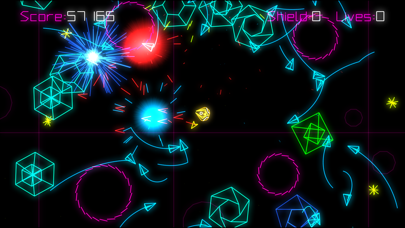
The Geometry Wars line is what happens when Asteroids’ DNA gets fed through a particle-effects compiler. The iPhone version is a proper port of the console release, not a watered-down mobile reskin — that distinction matters because the App Store has a lot of Geometry-Wars-shaped imitations and most of them don’t track. It remains a frequent top recommendation in iOS gaming communities for the twin-stick arcade slot.
base price with optional paid expansions for extra modes, so the “premium” label is partial. The base experience is generous; the upsell is honest.
PewPew Live (Twin-stick descendant)
PewPew has been the indie answer to Geometry Wars for over a decade and the developer has kept it sharp. Vector visuals — and these are actual vector visuals, not bitmap pretending — multiple game modes, ridiculous score ceilings, and a track record of clean updates. Controller support is solid if you’ve got an MFi pad. one-time purchase with optional cosmetic IAP; the full game is unlocked from the start.
If you want the Asteroids aesthetic but the gameplay energy of something newer, PewPew is the pick.
The physics-forward branch
This is where Asteroids’ premise gets taken seriously instead of nostalgically. The original game faked physics — friction was zero, gravity didn’t exist, asteroids drifted in straight lines because the hardware couldn’t do better. Modern hardware can do better. A small number of developers have actually tried.
Galaximus (Physics-forward)
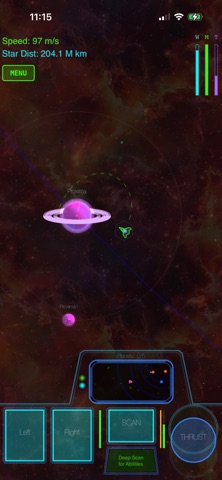
Galaximus is the most ambitious answer on the App Store to the question “what if Asteroids had real physics underneath?” Built by a solo developer with The Last of Us Part II on his shipping résumé, it’s a premium iPhone game where every celestial body obeys actual orbital mechanics — planets orbit suns, moons orbit planets, asteroids tumble through gravity wells, and the player ship is subject to all of it.
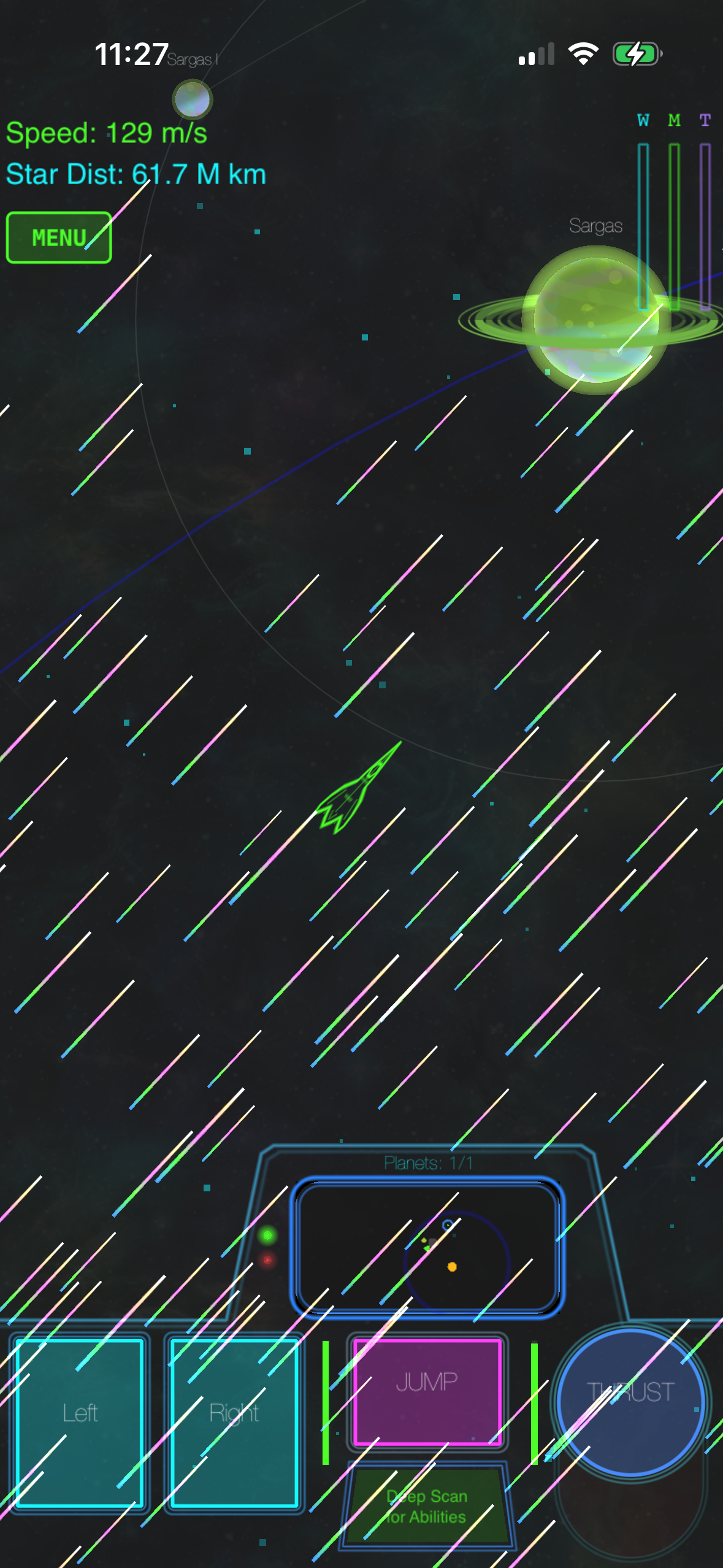
The arcade lineage is visible in the visuals (neon vector-style HUD, stylized abstraction over the physics) and the moment-to-moment combat. The departure is what’s underneath: gravity is the engine you have to learn to use. Slingshots around planets give you free speed. Orbital captures let you park instead of burn fuel holding position. Transfer windows between planets reward patience over twitch.
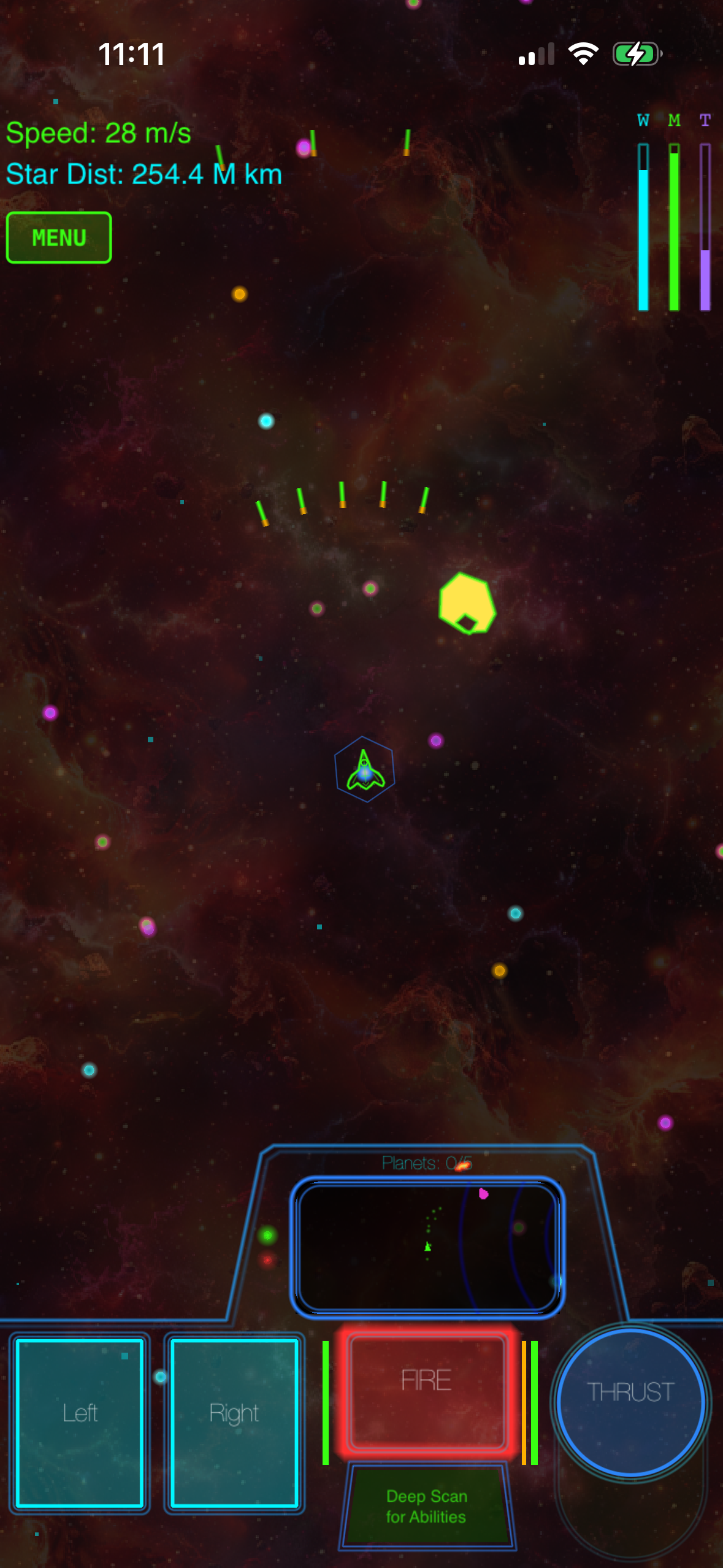
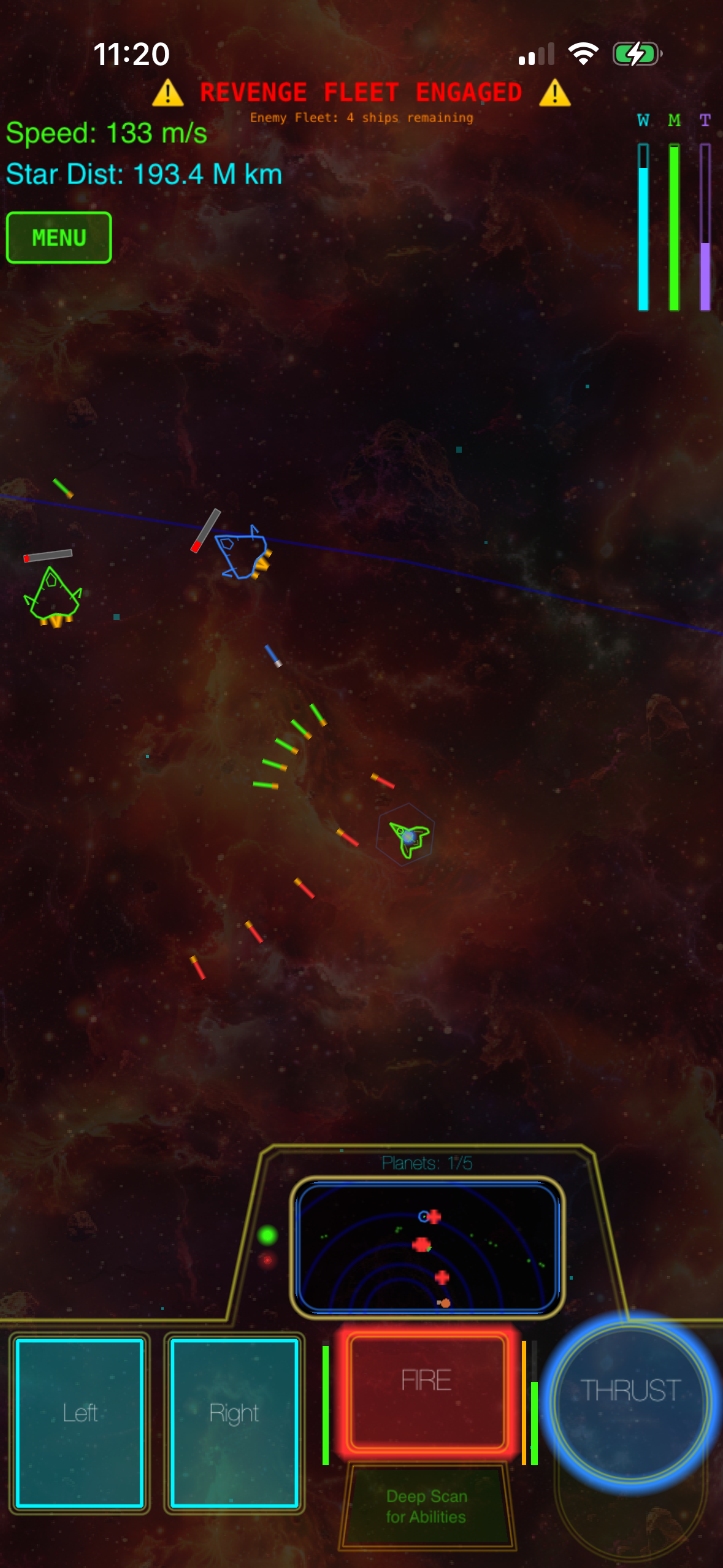
That last part is the honest tradeoff. Asteroids was pickup-and-play; Galaximus is not. The developer says so up front and so do owner reviews — the first thirty minutes are a real learning curve. After that, the physics stops being an obstacle and starts being expressive. The same skill that lets you whip around Proxima for a slingshot lets you set up a clean firing arc on a pirate fleet.
The campaign, per the developer, is eight procedurally configured star systems with a structured narrative arc — beginning, middle, satisfying ending. Per the developer’s published feature list, eleven unique anomaly encounter types are scattered through the systems (spacetime rifts, derelict ships, distress beacons), each a self-contained mini-experience. The Mirror, a spacetime-rift boss fight against a copy of yourself, is the kind of set-piece that wouldn’t exist in a faked-physics game.
Audio is procedural synthesis — every laser, engine burn, alien voice, and ambient hum is generated in real time on the device. No sound files. The technical choice maps cleanly onto the vector-arcade aesthetic and is the kind of detail you only notice as a positive, never as a negative.
Pricing matters to mention here. Galaximus is at the launch-price tier right now ( one-time purchase, no IAP). A major expansion called Galaximus Infinitum is in development for late 2026 — open-galaxy sandbox, planetary surface exploration, outpost building, faction warfare. Players who buy at the launch tier get Infinitum as a free upgrade. After Infinitum ships, the combined game moves to a higher price tier. That makes the current window a genuinely good buying moment if the game appeals at all.
Lunar Lander successors (honorable mention)
The Asteroids family tree includes Lunar Lander, which was Atari’s other 1979 vector game and a closer cousin than people remember — same hardware, same era, same physics-as-puzzle ethos. There’s no single dominant Lunar Lander remake on iOS in 2026 worth a section of its own, but if Galaximus’s gravity-as-engine premise sounds appealing and you want something simpler first, the iPhone Games with Vector Graphics: Minimalist Design Classics roundup — which catalogs current vector-style and minimalist iPhone games including thrust-and-gravity titles — has the better candidates in that branch.
What to avoid
The App Store has a depressing number of “Asteroids HD” listings that are reskinned f2p shells — ad break every two minutes, premium currency for extra ships, energy timers gating play sessions. Asteroids was a game you fed quarters to in 1979; it should not be a game you feed ads to in 2026. Filter ruthlessly. If a listing says “free” and “in-app purchases” together, it almost certainly is not in the spirit of the original.
The Indie iPhone Games Without Ads or IAP: Complete Guide 2026 guide — a curated list of premium iPhone games with no ads and no IAP — is the better starting point if you want to pre-filter for premium structure.
Picking between them
A rough decision tree, based on what readers actually report wanting:
- Want exactly Asteroids — rotate, thrust, shoot rocks, screen wrap — on a touchscreen? Vectros.
- Want fast-paced bullet patterns with particle effects and dual-thumbstick aiming? PewPew Live or Geometry Wars 3.
- Want a space game where orbital mechanics, slingshots, and gravity wells are the actual gameplay? Galaximus.
- Want 5-minute pickup-and-play sessions you can drop instantly with no mechanics to memorize? Vectros or PewPew. Galaximus is the wrong fit for that brief and the developer would tell you so.
The branches aren’t really competing — they’re answering different versions of the same nostalgia. Asteroids in 1979 was simultaneously a coin-op arcade game and a physics demo on hardware that could barely render geometry. The descendants split those threads. If you only buy one, buy the one that matches the thread you actually missed.
How this fits the broader arcade revival
The iPhone has quietly become the best home for arcade-lineage games in a decade. The screen is the right size, the hardware is overpowered for the format, and indie developers have figured out that touch controls work with minimal-input games rather than against them. The Retro Arcade iPhone Games Premium: 80s Nostalgia Done Right roundup — covering paid retro arcade games beyond just the Asteroids branch — and the iPhone Games Inspired by 80s Arcade: Authentic Throwback Titles piece — focused on modern games that emulate 1980s arcade design without being literal ports — cover the wider field; this piece is specifically the Asteroids branch.
For the controller-preferring crowd, Premium iPhone Games with Controller Support: Play Like Console — a guide to premium iPhone titles with full MFi controller support — is worth reading alongside. Most of the games above support MFi controllers, and Galaximus in particular benefits from one once you’re past the learning curve.
FAQ
Is the original Asteroids available on iPhone?
Atari has shipped various official Asteroids collections over the years, with availability that comes and goes. The Atari 50 anniversary collection has included the 1979 original in past releases; check the App Store for current status, as Atari’s mobile lineup shifts periodically. The faithful descendants above (Vectros especially) are often a better experience on a touchscreen than the literal port regardless.
Do any of these support MFi controllers?
PewPew Live, Geometry Wars 3, and Galaximus all support MFi controllers per their App Store listings. Vectros is touch-only based on owner reports. Controller support meaningfully changes the feel — twin-stick games in particular are designed around two thumbsticks.
Is Galaximus too hard for someone who just wants arcade fun?
Honestly, maybe. The developer is upfront that there’s a real 30-minute learning curve because gravity is the engine you have to master. If your appetite is for pickup-and-play sessions, PewPew or Vectros fit better. If you’re willing to invest 30 minutes for hours of expressive payoff, Galaximus is the deeper game in this list.
Are any of these free?
Geometry Wars 3 has a free-to-start tier with paid expansions; the others above are premium one-time purchases. Asteroids fans tend to want the premium model — the original was a complete, self-contained experience you paid for once (per quarter, in 1979), and the faithful descendants here honor that structure rather than the modern f2p treadmill.


