iPhone Games Inspired by 80s Arcade in 2026
iPhone Games Inspired by 80s Arcade: Authentic Throwback Titles
The 1980s arcade cabinet defined a whole language of game design—immediate challenge, clear feedback loops, and the constant hum of quarters feeding the machine. That aesthetic and mechanical philosophy didn’t disappear; it evolved. On iPhone in 2026, a crop of premium indie games have done the hard work of translating arcade-era sensibilities into modern controls and visuals without just slapping a retro filter on free-to-play junk. These are games that understand what made the originals work: tight mechanics, no padding, and the satisfying feeling that you failed because you weren’t good enough yet, not because the game was designed to exhaust you.
This guide covers games that trace their lineage back to the arcade floor—not just games that look retro, but games that play like they learned from Asteroids, Lunar Lander, Tempest, and Defender. We’ll look at what separates authentic arcade-inspired design from nostalgia-bait, and highlight specific titles worth your time and money.
What Makes a Game “Arcade-Inspired” vs. Just Retro-Styled
The distinction matters. A true arcade-lineage game respects the core loop of the original format: you have a clear objective, immediate feedback on every input, a skill ceiling you can practice toward, and no artificial delays between attempts. Retro styling—pixel art, chiptune audio, CRT scan lines—is window dressing. It can be part of the experience, but it’s not the foundation.
Authentic arcade-inspired iPhone games share a few key traits:
- One-life-or-lives structure, not energy timers. You fail, you restart. Immediately.
- Skill-based progression, not unlock trees. Better players beat harder waves; worse players don’t.
- Minimal UI friction. Menus don’t interrupt the loop. You go from “game over” to “next attempt” in one tap.
- Honest difficulty scaling. The game gets harder because enemies are faster or smarter, not because the developer locked content behind a paywall or a time gate.
Games that nail this feel like they were designed by people who understood why you pumped quarters into a cabinet for hours. Games that miss it feel like they’re using arcade aesthetics as a trojan horse for the same monetization patterns that made mobile gaming exhausting.
The Vector-Graphics Aesthetic and Why It Matters
Many of the best arcade-inspired iPhone games lean into vector graphics—clean lines, neon colors, minimal detail. This isn’t nostalgia; it’s smart design. Vector graphics scale perfectly across different iPhone screen sizes, they run efficiently on older hardware, and they create a visual language that’s instantly readable at a glance. When you’re moving fast and making split-second decisions, visual clarity is survival.
The vector-arcade style also sidesteps the “pixel art on modern screens” problem. Pixel art from the 1980s was a constraint—low resolution, limited color palettes. Scaling pixel art up to a modern Retina display either looks blurry or requires integer scaling that wastes screen real estate. Vector graphics were born for this era. They feel retro in spirit but modern in execution.
Games like Asteroids and Tempest pioneered this visual language on arcade hardware, and modern iPhone games have learned to evolve it rather than just replicate it. The result is games that feel ancestral to the originals without pretending to be 1981.
The Premium Model: Why One-Time Purchase Matters Here
Most arcade-inspired games on the App Store are free-to-play with ads, energy timers, and battle passes. They’re using the arcade aesthetic to sell a different monetization model entirely. The games worth your attention are premium—one-time purchase, no ads, no in-app purchases, no energy meter.
This model matters because arcade games were designed around mastery, not engagement metrics. An arcade cabinet made money by being good enough that players wanted to beat it, not by locking you out every three attempts until you paid. Premium iPhone games restore that alignment: the developer’s incentive is to make something good enough that you want to keep playing, not something designed to frustrate you into spending.
Most premium arcade-inspired iPhone games land in the budget-to-mid-tier price range. You’re paying what a movie ticket costs, once, and you own the game forever. No surprises, no timers, no “come back in 4 hours” messages.
Core Game Types: What You’ll Find
Asteroids Lineage
Games descended from Asteroids (1979) put you in a small ship surrounded by hazards you destroy by shooting. The player ship is usually vulnerable but maneuverable—skill comes from positioning and timing, not reflexes alone.
Geometry Wars (, App Store) modernizes this format with procedurally generated enemy patterns and multiple weapon types. Every shot feels impactful, and the game respects the one-life structure of the original while adding visual complexity that would’ve been impossible in 1979.
Hyper (, App Store) strips the format down further—you’re a small shape in a neon arena, destroying incoming threats. Minimal visual noise, maximum clarity. The skill ceiling is high; the learning curve is steep.
Modern takes on this format add layers: procedurally generated enemy patterns, multiple weapon types, gravity mechanics that force you to think about momentum. The best ones feel like Asteroids if the original designers had access to modern processing power and weren’t constrained by arcade hardware limitations.
Space Exploration and Gravity
A newer lineage (pioneered by games like Lunar Lander) focuses on using gravity as a core mechanic. You’re piloting a ship, managing fuel, and using planetary gravity wells to your advantage. This requires patient positioning and understanding of physics, not twitch reflexes.
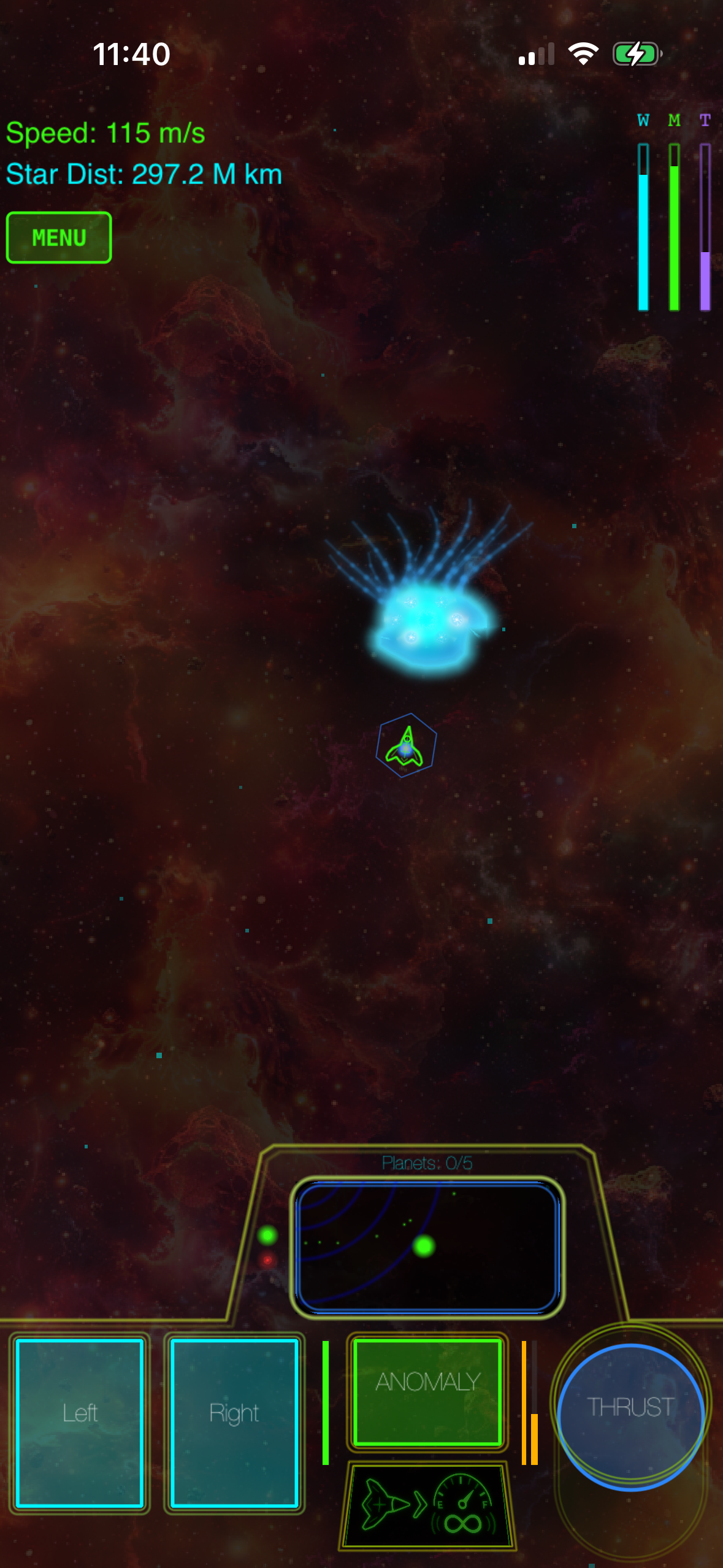
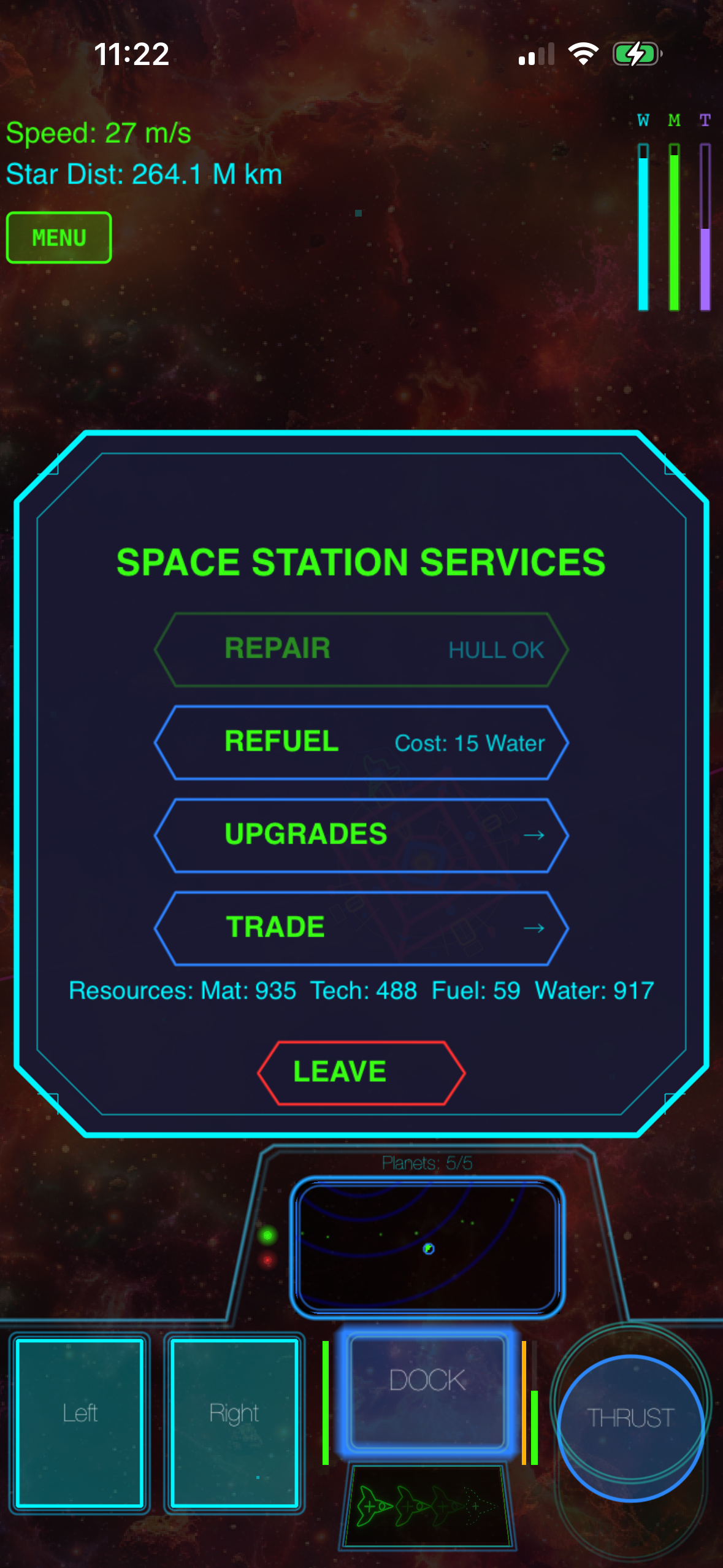
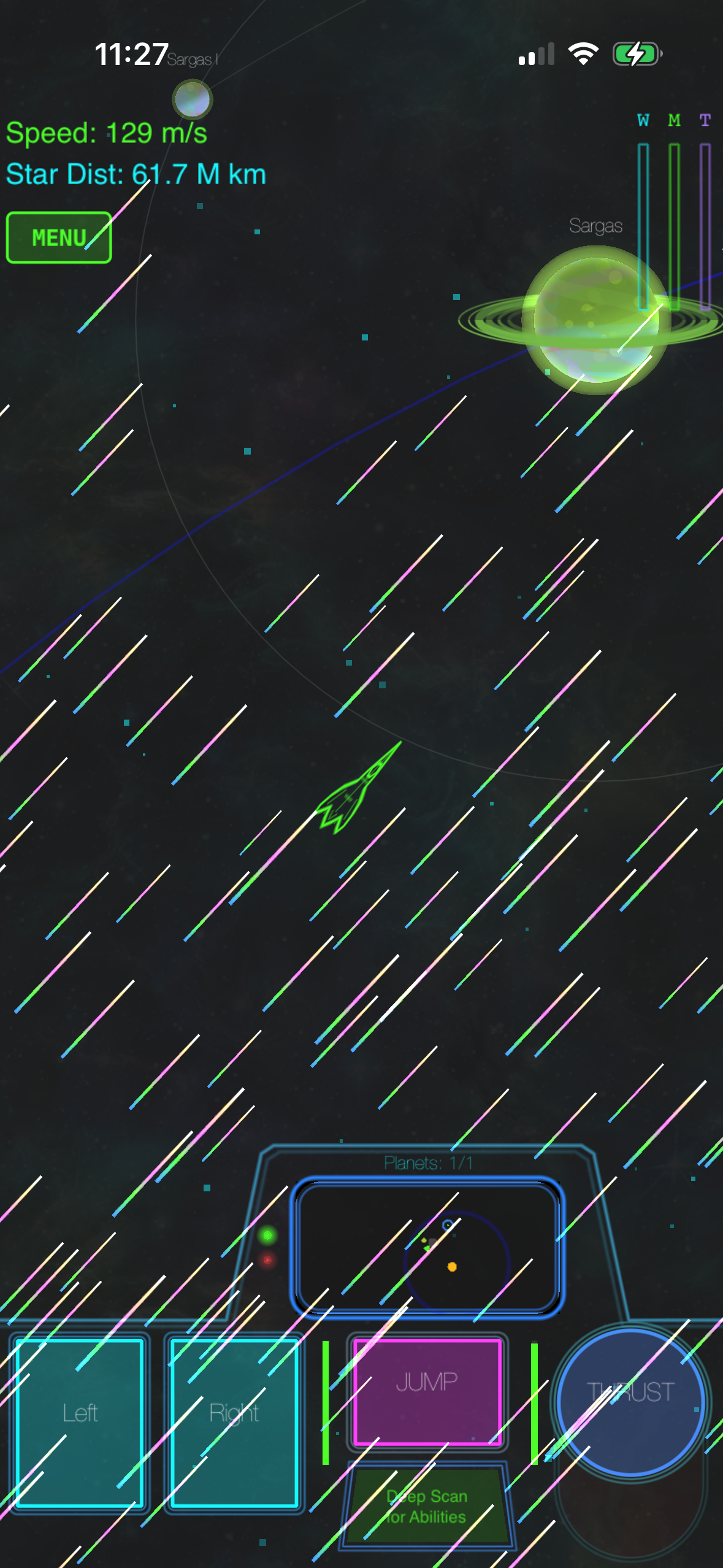
Galaximus (, App Store) stands out as the exemplar here. Real orbital mechanics form the core gameplay loop—every celestial body exerts gravity on every other body in real time. You’re not just flying through space; you’re using gravity as your engine, planning slingshots around planets to gain speed for free. The learning curve is real (gravity is unintuitive if you’ve never thought about it), but mastery is achievable and deeply satisfying. The game ships complete with a structured 8-system campaign, no ads, no IAP.
Games in this space often feature procedurally generated systems where each playthrough is unique. The skill ceiling is high—learning to use gravity efficiently takes practice—but the payoff is real mastery, not just memorized patterns.
Arcade Shooters and Wave-Based Combat
The classic “survive increasingly hard waves of enemies” format. These games test your ability to manage multiple threats at once, stay calm under pressure, and recognize patterns in enemy behavior.
Polarity (, App Store) uses the tube-based arena concept from Tempest but evolves it with modern mechanics. You’re defending a space against incoming threats, and the arena itself becomes part of the puzzle. The difficulty curve is well-tuned—accessible early, genuinely challenging later.
The best modern versions add a twist: maybe you’re managing resources between waves, or the arena itself is hazardous, or your weapons have trade-offs that force you to choose a strategy. The core is still wave-based combat, but it’s not just “tap faster than yesterday.”
Why 80s Arcade Design Still Works in 2026
The 1980s arcade golden age wasn’t about graphics or processing power. It was about clarity of purpose. You knew what you were supposed to do. You knew when you failed. You knew that if you played better, you’d do better. There was no ambiguity, no hidden mechanics, no surprise monetization.
That directness is rarer now than it was then. Most mobile games are built to optimize for engagement metrics and retention curves. Arcade-inspired games that respect the original design philosophy feel clean by comparison—almost austere. You’re not fighting the UI. You’re not waiting for timers. You’re not being asked to watch an ad to continue.
The other reason arcade design endures: it’s genuinely difficult to execute well. A bad arcade game is obviously bad—you can feel immediately when the controls don’t respond right, when the difficulty curve is broken, when the feedback isn’t satisfying. There’s nowhere to hide. This is why premium arcade-inspired games tend to be well-made: if they’re not, they fail instantly. The developers can’t paper over the cracks with cosmetics or monetization pressure.
What to Avoid: Retro-Styled Games That Miss the Point
Not every game with vector graphics and a chiptune soundtrack is arcade-inspired. Watch for these red flags:
- Energy meters and timers. If the game limits your attempts with a “come back in 4 hours” message, it’s not arcade-inspired—it’s arcade-themed.
- Aggressive monetization. Premium currency, battle passes, loot boxes disguised as arcade nostalgia. The original arcades made money by being good, not by psychological pressure.
- Opaque progression systems. If you can’t tell why you failed, or if failure feels arbitrary, it’s not arcade design. Arcade games are transparent about their rules.
- Ads interrupting gameplay. Arcade cabinets didn’t pause to show you an advertisement. Neither should a premium arcade-inspired game.
- Cosmetic-only progression. If your only reward for winning is a new skin or a cosmetic upgrade, the core loop is broken. Arcade games reward you with harder challenges, not prettier graphics.
The litmus test: would this game work in an arcade cabinet? If the answer is “no, because it relies on timers and monetization pressure,” it’s not arcade-inspired—it’s arcade-themed.
The Role of Procedural Generation
Many modern arcade-inspired games use procedural generation to add replay value. Each playthrough generates unique enemy patterns, star systems, or arena layouts. This serves two purposes:
- It extends the game’s lifespan. A hand-crafted 10-level arcade game gets old after you memorize all the patterns. Procedurally generated content means you’re always facing new challenges.
- It respects the arcade philosophy. Arcade cabinets were designed to be replayed infinitely. Procedural generation captures that infinite-replay quality digitally.
The best implementations use procedural generation to create variety, not randomness. The patterns should feel fair—you should be able to recognize why you failed and improve next time—but different enough that you’re not memorizing the same sequence over and over.
FAQ
How much storage do these games require?
Most premium arcade-inspired games are lightweight—typically 50–200 MB. They don’t rely on high-resolution assets or complex cinematics. Galaximus, for example, is under 100 MB. You can comfortably install several without worrying about storage constraints on a modern iPhone.
Do they work offline?
Yes. These are single-player games with no online components. Download them once and play anywhere, anytime, without an internet connection. This is another advantage of the premium model—no server dependency, no “check your connection” interruptions.
What’s the learning curve like?
Most arcade-inspired games have a gentle tutorial that teaches controls within the first 5 minutes. The real learning curve comes from understanding enemy patterns and developing muscle memory. Expect 30–60 minutes before you feel comfortable, and several hours before you’re genuinely skilled. The payoff is that improvement is measurable and satisfying.
Why are arcade games so difficult?
Difficulty is the point. Arcade games were designed to be challenging so players would feed more quarters into the machine. Modern arcade-inspired games preserve that challenge because it’s what makes mastery feel real. If you want a relaxing experience, these aren’t for you. If you want to feel yourself actually improve at something, they’re ideal.
Can I play these casually, or do they demand constant attention?
Most arcade-inspired games demand attention during active play—you can’t pause and walk away. But individual runs are short (5–15 minutes typically), so you can play in bursts. They’re not designed to consume hours in a single session; they’re designed to be replayed many times.
The Arcade Spirit Lives On
The best arcade-inspired games on iPhone in 2026 aren’t trying to recreate the 1980s. They’re trying to preserve what made arcade design work—clarity, fairness, and the satisfaction of mastery—and apply it to modern hardware and modern game design. They’re proof that the arcade philosophy wasn’t bound to cathode-ray tubes and wooden cabinets. It was bound to something deeper: the idea that a game should be good enough that you want to keep playing, not something designed to manipulate you into spending.
If you’re tired of energy timers and battle passes, if you remember when games shipped complete, if you want to feel yourself actually improve at something you’re playing, arcade-inspired games are where to look. They’re not for everyone—the skill ceiling is real, and the learning curve can be steep. But for players willing to invest the time, they offer something rare in mobile gaming: honest challenge and genuine mastery.
Start with a game that matches your interest—space exploration with Galaximus, wave-based combat with Polarity, or classic shooting with Geometry Wars—and give yourself at least 30 minutes to learn the controls. The payoff is real.