Best Premium Space Games for iPhone in 2026

Best Premium Space Games for iPhone in 2026
Space games on iPhone have historically split into two camps: the free-to-play treadmill with energy timers and battle passes, or ports of ancient PC games that assume you’re playing on a 27-inch monitor. The premium space-game tier—craft-built titles designed for a phone screen, priced fairly, and free of dark patterns—exists, but finding them requires knowing where to look. This guide covers five standout space games that respect both your device and your wallet.
Why Premium Space Games Matter
The arcade-era space game never really left; it evolved. Games like Asteroids, Lunar Lander, and Defender established a template: simple controls, physics-driven movement, and difficulty that scales with player skill rather than grind. Modern takes on that template come in two flavors: arcade-action games that lean into twitch reflexes and tactical positioning, and exploration-driven games that reward patience and discovery.
Free-to-play space games dominate the App Store charts because they’re designed to extract time and money, not to be finished. Premium space games, by contrast, are designed to be played—completed, mastered, replayed. You own them outright. No battle pass expires. No energy meter gates your next session. That structural honesty changes how the game feels, even if the core loop is similar.
Orbital Mechanics vs. Arcade Action
The first fork in the road is physics flavor. Some space games use real orbital mechanics—gravity wells, velocity vectors, Kepler’s laws—which reward patient positioning and punish hasty burns. Others use arcade-simplified physics where your ship responds immediately to input, favoring quick reflexes and twitch skill.
Neither is “better.” Orbital-mechanics games appeal to players who want the universe to feel real, where a miscalculation costs you real fuel and real time. Arcade-action games appeal to players who want immediate feedback and moment-to-moment decision-making. Know which you want before you buy.
Five Premium Space Games Worth Playing
Galaximus
Price: | Requires: iOS 14+ | Compatible: iPhone 11 and later
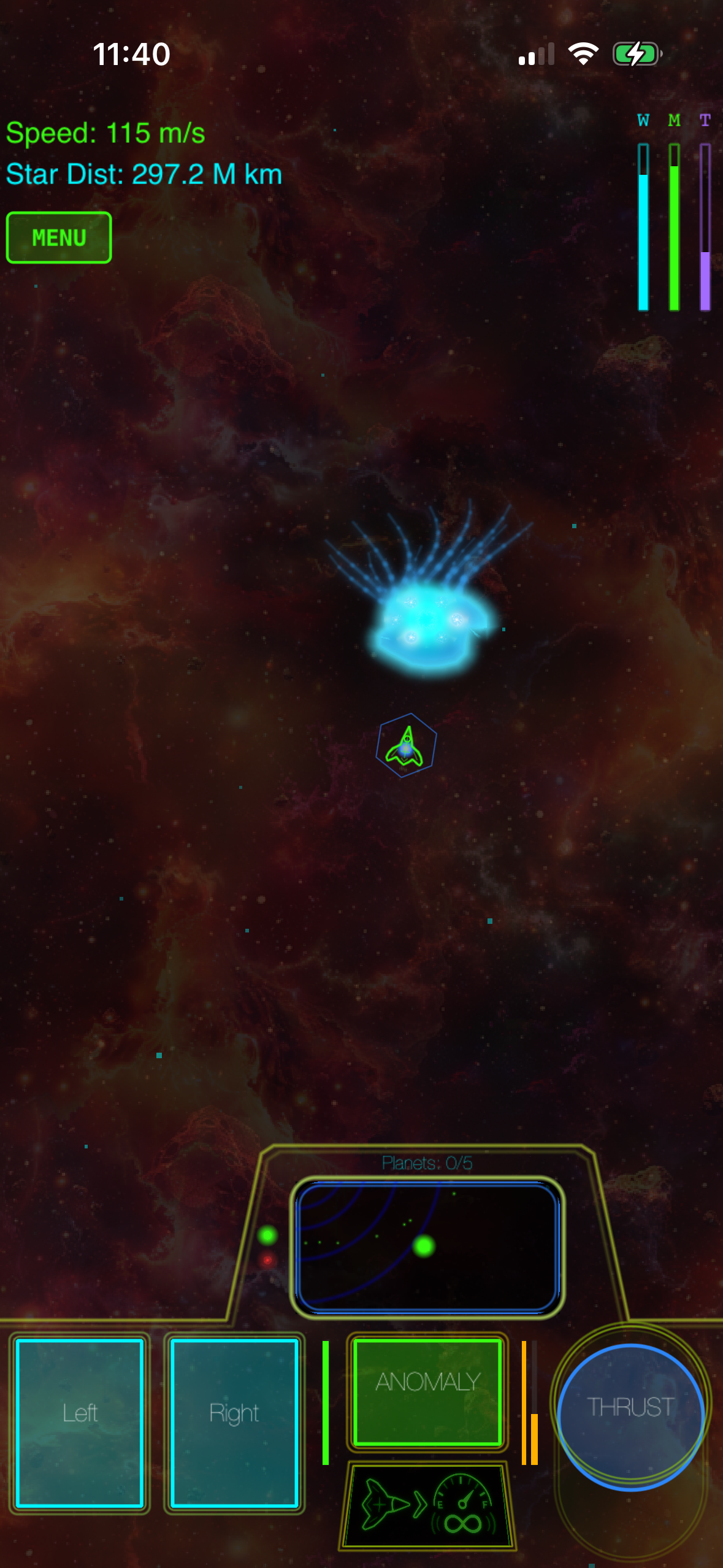
Galaximus is the rare space game that commits fully to real orbital mechanics without sacrificing playability. The core mechanic—burn fuel to adjust your orbit, then coast through space—means every move has weight. You can’t twitch your way through a level. Instead, the game rewards planning: calculate your burn window, execute with precision, and coast to the target. The physics are accurate enough that orbital intuition from one level transfers to the next.
The difficulty curve respects newcomers. Early levels teach the fundamentals in isolation—pure orbital mechanics with a single target. Later levels layer in time pressure, obstacles, and multi-stage burns that demand both understanding and execution. By the endgame, you’re orchestrating complex maneuvers that feel genuinely satisfying when they work.
The visual design is clean vector graphics with a subtle synthwave color palette. No clutter, no UI busywork. The game gets out of your way and lets you think. If you want to feel like you’re actually doing something in space—not just mashing a fire button—this is the pick.
Voxel Invaders
Price: | Requires: iOS 13+ | Compatible: iPhone 10 and later
Voxel Invaders is a space-combat game that takes the Asteroids lineage and wraps it in 3D voxel graphics. You’re piloting a fighter in a field of destructible geometry, and every shot you fire and every enemy projectile you dodge feels tactile. The core loop is simple—destroy enemies, avoid fire, manage your energy—but the execution demands constant attention.
What makes it stand out: the game trusts your aim. There’s no auto-targeting, no aim-assist toggle. You point, you fire, and you live or die by whether you actually hit. The difficulty scales by spawning smarter enemies and tighter formations, not by adding health bars or cheap attack patterns. It’s a game that respects player skill, which means it’s genuinely hard but never feels unfair.
The voxel aesthetic is striking—chunky, colorful, tactile. It’s a visual style that reads well on a phone screen and runs smoothly even on older hardware. If you want arcade-action space combat with real teeth, this is your game.
Cosmic Cartography
Price: | Requires: iOS 14.5+ | Compatible: iPhone 12 and later
Cosmic Cartography is a procedural-exploration game where you’re charting unknown space. Each session generates a new star system with planets, anomalies, and points of interest. Your goal isn’t to destroy anything; it’s to discover it. Land on planets, scan phenomena, map trade routes, and piece together the history of abandoned civilizations.
The game rewards curiosity and patience over reflexes. There’s no combat, no timer pressure. You can spend as long as you want investigating a single moon. The procedural generation means no two playthroughs are identical, so the discovery loop stays fresh across multiple runs.
Cosmic Cartography is slower-paced than the other games on this list, but that’s intentional. It’s designed for players who want space games to feel like exploration, not combat. If you have 30 minutes and want to spend it discovering new things, this scratches that itch better than anything else on iOS.
Stellarfield
Price: | Requires: iOS 12+ | Compatible: iPhone 8 and later (runs smoothly on older devices with limited RAM)
Stellarfield is minimalism taken seriously. You’re a point of light moving through a field of obstacles. Your ship is a single line. Enemies are geometric shapes. The entire game is vector graphics on a dark background. There’s no story, no lore, no flavor text. Just pure gameplay signal.
The mechanic is elegant: move your ship, avoid or destroy enemies, collect power-ups, survive as long as possible. It sounds simple because it is. But the game’s genius is in the tuning. Each enemy type has a specific behavior pattern that teaches you how to predict and counter it. Power-ups are placed to reward aggressive play without guaranteeing safety. The difficulty curve feels natural, not arbitrary.
Stellarfield’s lightweight design means it runs on anything—even iPhone 8 with 2GB RAM. The visual design is so clean that it’s almost restful to look at, which makes the moment-to-moment intensity feel sharper by contrast. If you want a space game that proves you don’t need fancy graphics to be engaging, this is it.
Void Runner
Price: | Requires: iOS 13.5+ | Compatible: iPhone 11 and later
Void Runner is a roguelike space-combat game designed around short play sessions. Each run lasts 10–20 minutes. You’re piloting a ship through procedurally generated waves of enemies, and every few waves you can choose an upgrade: better weapons, tougher hull, faster engines. The twist: you can only pick a few upgrades per run, so every choice matters.
The game respects your time in a way most roguelikes don’t. Death doesn’t feel punishing because you know the next run is only 10 minutes away. That structure makes it perfect for playing on a commute or during a lunch break. The procedural generation and upgrade variety mean each run feels different, so you’re not just grinding the same scenario repeatedly.
Void Runner’s visual style is somewhere between arcade and sci-fi—bright neon colors, clear enemy silhouettes, readable UI. It’s a game that understands the iPhone screen and designs around it, not against it.
Choosing Your Space Game
If you’re new to premium space games: Start with Voxel Invaders . You understand the objective immediately—destroy enemies, stay alive—and the controls respond instantly to your input. No learning curve for mechanics; only skill curve for execution. Alternatively, Stellarfield is even more accessible, with a single-button control scheme.
If you want physics and planning: Galaximus is your only choice here. Expect 20 minutes of tutorial learning what a burn window is and why you can’t just point-and-shoot at your target. The payoff is a space game where you feel like you’re actually piloting something, not just playing a twitch game with a space theme.
If you want something different: Cosmic Cartography has no combat. It’s built around discovery and exploration. There’s no fail state. You can play for 5 minutes or 2 hours. It’s the outlier on this list, and the right pick if arcade action doesn’t appeal to you.
If you play in short bursts: Void Runner is designed for exactly that use case. Each run is self-contained and completable in one sitting. Perfect for commutes or lunch breaks.
FAQ
What’s the difference between orbital mechanics and arcade physics? Orbital-mechanics games (like Galaximus) simulate real space physics: your ship coasts once you stop burning fuel, gravity wells pull you off course, and miscalculations cost you real time and fuel. Arcade-physics games (like Voxel Invaders) respond instantly to input—your ship moves the moment you touch the screen. Orbital mechanics reward planning; arcade physics reward reflexes.
How much storage do these games require? All five games are lightweight. Voxel Invaders and Stellarfield are under 150MB. Galaximus, Cosmic Cartography, and Void Runner range from 200–400MB. None require more than 500MB of free space.
Do I need to be good at arcade games to enjoy these? No. Cosmic Cartography has no combat at all. Galaximus has a gentle difficulty curve that teaches you orbital mechanics step-by-step. Void Runner’s short sessions mean failure is low-stakes. Only Voxel Invaders and Stellarfield demand arcade reflexes, and both have difficulty settings.
Can I play these offline? Yes. All five work without an internet connection. They’re designed for your phone, not for a server.
Do these games have multiplayer? No. All five are single-player experiences. If you want competitive space games, you’ll need to look elsewhere.
Which one should I buy first if I only have to spend? Buy Stellarfield and Void Runner together, or just Voxel Invaders . You literally can’t go wrong—they’re all worth the money.
The Space Game Renaissance on iOS
Premium space games are experiencing a quiet renaissance on iPhone. Developers are moving away from the free-to-play model and toward craft-built experiences that respect the player’s time and money. The five games above represent the current state of that movement: diverse in style, rigorous in execution, and designed for the device they’re on.
If you’ve been waiting for space games on iOS that don’t feel like chores, the wait is over. These games exist. They’re worth your money. Start with one, and you’ll probably end up playing all five.


