Indie iPhone Games Under $3: Best Value Picks for 2026

Photo by Onur Binay on Unsplash
Indie iPhone Games Under $3: Where Real Craft Meets Budget Pricing
At budget-tier prices, you’d expect indie games to cut corners—shorter campaigns, stripped-down mechanics, or the dreaded ad breaks that kill immersion every few minutes. Instead, a handful of developers have proven that genuine craft doesn’t require a premium price tag. This roundup covers five games that cost less than a coffee and deliver the kind of focused, complete experience that makes you wonder why anyone bothers with free-to-play energy timers.
Why Budget-Tier Indie Games Matter
The App Store’s race to free-to-play has created a peculiar gap: genuinely finished, IAP-free games at budget prices are rarer than they should be. When a developer charges under three dollars and commits to zero ads and zero in-app purchases, they’re betting that craft and focus matter more than monetization tricks. That bet, when it pays off, yields games that feel complete—not truncated demos designed to nag you into spending more.
The games below share a philosophy: one strong idea, executed with precision, priced to acknowledge that phones are a casual-play medium but refusing to treat casual players as targets for extraction. Each has been shaped by years of iteration and each plays like the developer’s full attention landed on mechanics and feel rather than engagement hooks.
Asteroid: Vector Physics Done Right
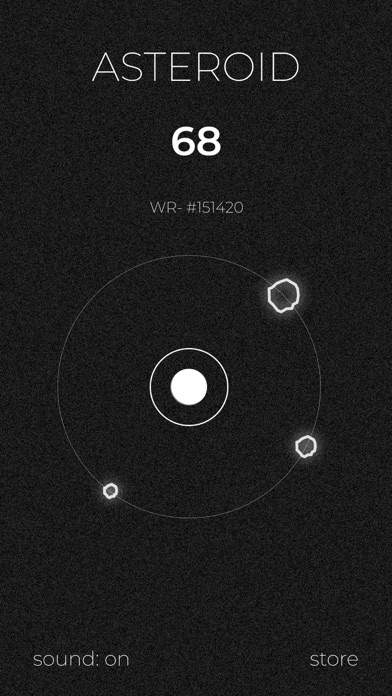
Asteroid strips arcade-lineage gameplay to its essence: rotate, thrust, shoot, and manage screen wrap. What separates this from other asteroid clones is the physics model. The orbital mechanics reward patient positioning and momentum management over twitch reflexes—you’ll spend more time thinking about where your ship will be than mashing the fire button. The vector-graphics aesthetic reads as intentional craft rather than budget compromise; every collision feels weighty, every explosion carries impact.
The game respects the 1979 original without trying to “modernize” it into something unrecognizable. Difficulty escalates gradually; early sessions teach you rotation and thrust timing, while later play demands three-move-ahead planning. Typical session: 8-12 minutes per run, with high-score chasing sustaining weeks of play.
Duet: One Mechanic, Infinite Depth
Duet presents two rotating circles on a dark screen and a stream of obstacles moving toward them. Your job: rotate the circles to dodge. That’s the entire game, and it’s a masterclass in how much depth emerges from a single constraint.
The genius lies in the level design. Early stages teach you how the circles behave—rotation speed, momentum, collision boundaries. By level 20, you’re reading ahead three obstacles, predicting the angles you’ll need, and executing rotations that feel like rhythm-game timing. There’s no menu clutter, no story, no systems to unlock—just you, the circles, and the next obstacle. The minimalist aesthetic means the game runs smoothly even on older hardware and feels timeless rather than trendy. Typical session: 10-15 minutes, with difficulty escalating at a pace that sustains engagement across weeks.
Threes!: Puzzle Craft Without the Grind
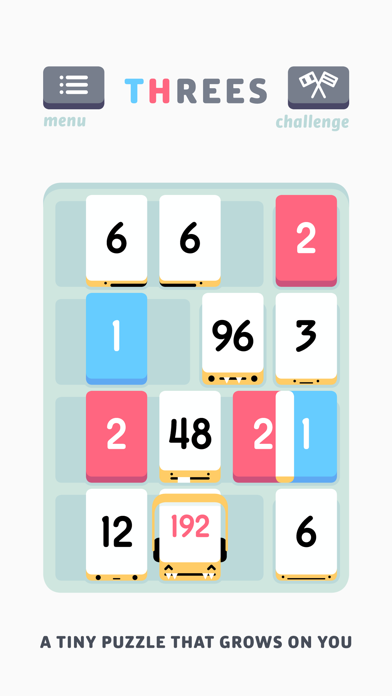
Threes! is a sliding-tile puzzle where you combine numbered tiles to create larger numbers—1+1=2, 2+2=4, and so on. It sounds simple enough that a thousand free-to-play clones have ripped off the core mechanic. What sets Threes! apart is the restraint: there’s no timer, no ads, no “continue for gems,” and no pressure to spend money to unlock tiles or moves. Unlike free-to-play versions that gate progression behind energy timers, Threes! lets you play continuously.
Instead, the game trusts that the puzzle itself is engaging enough. The board is small (4x4), which means every move matters and careless play ends your run quickly. The tile combinations create emergent patterns—you learn that certain sequences of moves open up board space, that holding back from the highest-number combinations sometimes yields better long-term positioning. Typical session: 10-20 minutes per run; you can play dozens across a week and feel like you’re making progress toward a personal high score rather than grinding toward a monetization threshold.
Two Dots: Simplicity With Strategic Layers
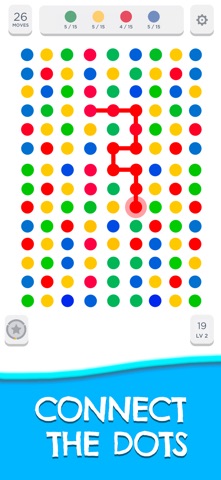
Two Dots asks you to connect same-colored dots on a grid by drawing lines between adjacent dots. Close the loop, clear the dots, advance. The first few levels take 30 seconds each. By level 40, you’re planning three moves ahead, spotting board patterns, and managing the spatial constraints that make the puzzle harder without adding arbitrary rules.
The game’s strength is how it layers complexity without ever adding a new mechanic. You’re always connecting dots; the puzzle just gets smarter about forcing you to think in new ways. Some levels demand that you spot a specific path among dozens of possibilities. Others require you to use one color’s dots as stepping stones to reach another color. Like Threes!, Two Dots refuses to monetize your engagement—no energy timers, no ads, no “buy hints” buttons. Typical session: 8-12 minutes per run, with escalating difficulty sustaining engagement across weeks.
Mini Metro: Transit Puzzles in Five-Minute Bites
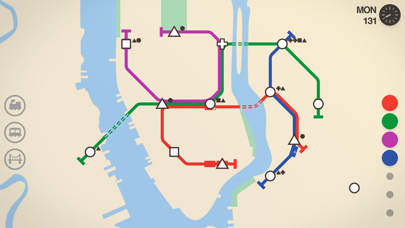
Mini Metro casts you as a transit planner designing subway lines for a growing city. You draw lines connecting stations; passengers board and ride to their destinations. As the city expands, more stations appear, and you optimize your network to keep passengers moving. The mechanic is elegant: draw a line, watch it work, adjust when it breaks down.
What makes Mini Metro special is how it scales from zen to frantic. Early games feel almost meditative—you have time to think, space to plan, and the satisfaction of watching a clean network hum. Later games demand rapid decisions; a new station appears and you have seconds to route it before passenger backlogs explode. The game doesn’t punish you with a hard fail state—the game simply ends when you can’t keep up—but the challenge is real and escalates at a pace that keeps you engaged. The minimalist aesthetic means the game is as pleasant to look at as it is to play. Typical session: 5-15 minutes per run, with replayability sustaining ongoing engagement.
How to Evaluate Budget-Tier Indie Games
Not every game under three dollars deserves your attention. Some are genuinely unfinished; others are old ports that haven’t aged well. Here’s what to look for:
- Zero ads, zero IAP. If the App Store listing mentions either, it’s not a true premium game regardless of price. Duet and Mini Metro have no energy timers, unlike free-to-play alternatives that gate progression behind wait times.
- Focused scope. Games that try to do everything often do nothing well. Look for titles with a single strong mechanic or a narrow creative vision. Asteroid’s commitment to orbital physics over twitch reflexes is an example of this focus.
- Longevity signals. Check the release date and update history. Games that have been maintained for years tend to be more polished than day-one releases.
- Player reviews that mention specific mechanics. Generic praise (“great game!”) is noise. Reviews that describe how the game plays reveal whether it matches your taste.
- No energy timers, no battle pass, no seasonal content. These are monetization hooks disguised as features. A complete game doesn’t need them. Threes! and Two Dots exemplify this by offering unlimited play sessions.
FAQ
Can I play these games offline? Yes. All five games work without an internet connection. They’re designed for local play and don’t require cloud syncing or online features.
Do these games sync across devices? Most don’t sync progress between iPhone and iPad or between multiple devices. They store progress locally on each device. If you play on multiple devices, you’ll maintain separate high scores and progress on each.
What happens if I delete a game—can I reinstall it without paying again? Yes. Once you’ve purchased a game on your Apple ID, you can reinstall it on any device linked to that account without paying again. The purchase is tied to your account, not the device.
Do these games work on older iPhones? Most do. The games in this roundup use relatively modest graphics and don’t require the latest hardware. Asteroid, Duet, and Mini Metro run on iPhone 6S and later; check the App Store listing for your specific device, but budget-tier indie games tend to be less demanding than premium-tier titles or free-to-play games.
Why are these games so cheap if they’re genuinely good? Developers price games at what they believe the market will bear. A budget price reflects confidence in the game’s quality and a philosophy that accessibility matters more than maximizing revenue per player. Many of these games were released years ago when the App Store was less crowded; they’ve simply maintained their original pricing as they’ve aged.
Are there other games worth buying? Yes. The App Store has hundreds of premium indie games at budget prices. The five here represent a specific style—arcade lineage, puzzle craft, and minimalist aesthetics—but your taste might lead you elsewhere. Use the evaluation criteria above and read player reviews that mention specific mechanics rather than generic praise.
The Case for Paying a Little for a Lot
The indie games market has fractured into two tiers: free-to-play with aggressive monetization, and premium games at higher prices. The budget-tier games under three dollars are a third path, and they’re worth exploring. You’re not paying much, but you’re paying enough that the developer chose craft over extraction. That choice shows in every system, every level, every moment of play.
If you’re tired of energy timers and ad breaks, or if you simply want a focused, complete game that respects your time, these five are a genuinely good place to start. At budget-tier prices, the risk is minimal and the upside—discovering a game that becomes part of your regular rotation—is real.
For a deeper dive into why premium indie games matter and how they compare to free-to-play models, see Indie iPhone Games vs Free-to-Play: Why Premium Wins. If you’re looking for games with zero ads and zero IAP across all price tiers, iPhone Games With No Ads and No IAP: Complete Guide covers a broader range of options. And if you want to explore how to find quality indie games beyond the usual App Store charts, How to Find Quality Indie Games on the App Store offers practical strategies for discovery.