iPhone Games Like Asteroids: Modern Takes on Classic Arcade
iPhone Games Like Asteroids: Modern Takes on Classic Arcade
The original Asteroids arcade cabinet from 1979 set a template that still works: point your ship, manage momentum, aim for survival. Forty-seven years later, iPhone games are still chasing that feeling—but the best ones aren’t clones. They’re lineage games that respect the formula and add something that only modern hardware makes possible.
If you’re looking for that specific blend of twitch skill, physics-based positioning, and the satisfaction of a perfect slingshot maneuver, these modern takes nail it. Most are premium, all are IAP-free, and none will interrupt you with an energy timer.
What Made Asteroids Timeless
Before we talk about modern descendants, understand what made the original work. Asteroids wasn’t about reflexes alone—it was about momentum. Your ship had weight. It drifted. You couldn’t stop on a dime; you had to plan three moves ahead, using inertia as a tool. The rock-smashing was just the excuse; the real game was flying.
That’s why so many iPhone games still chase it. Momentum-based flight, when done well, creates a skill ceiling that rewards practice in a way tap-to-move never does. The best modern takes lean into that physics-first design.
Galaximus: Gravity as the Entire Game
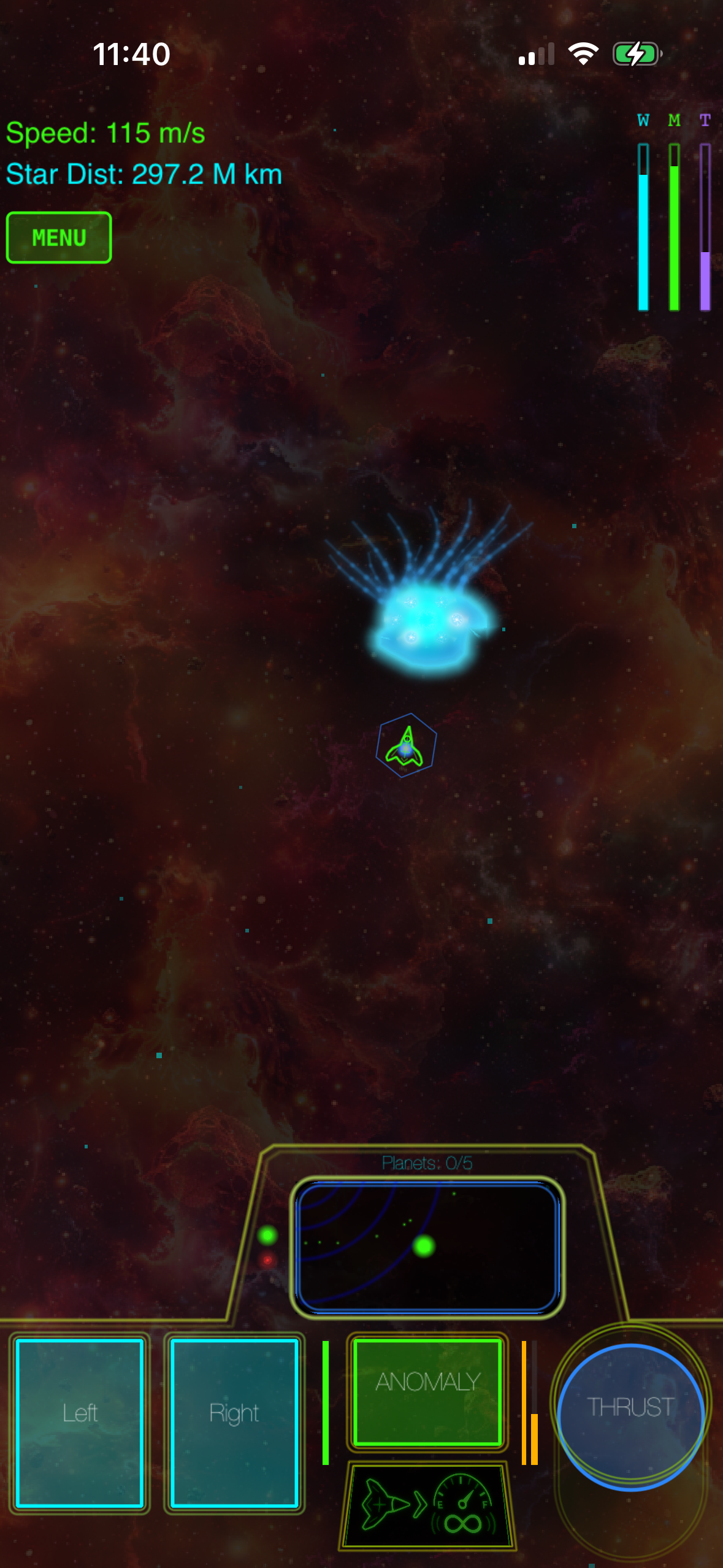
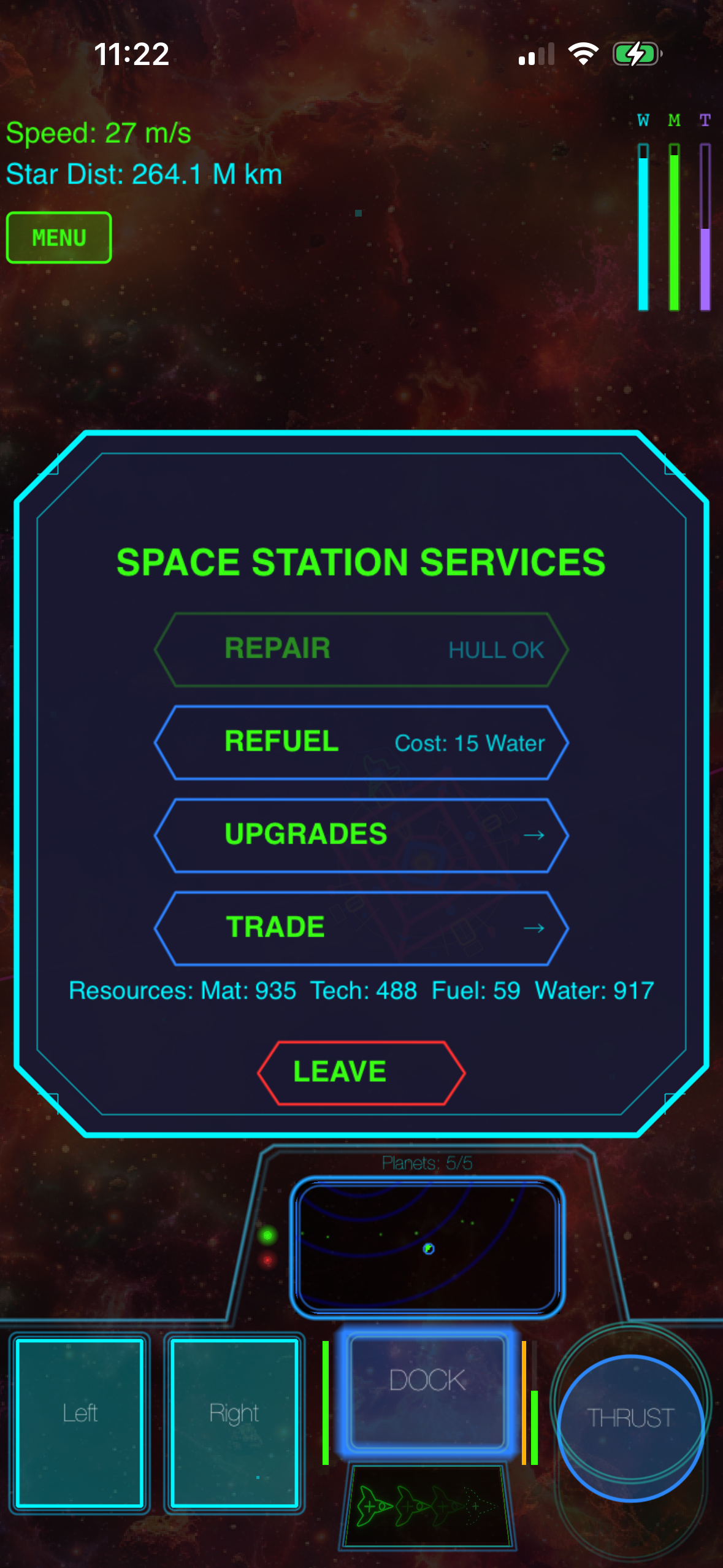
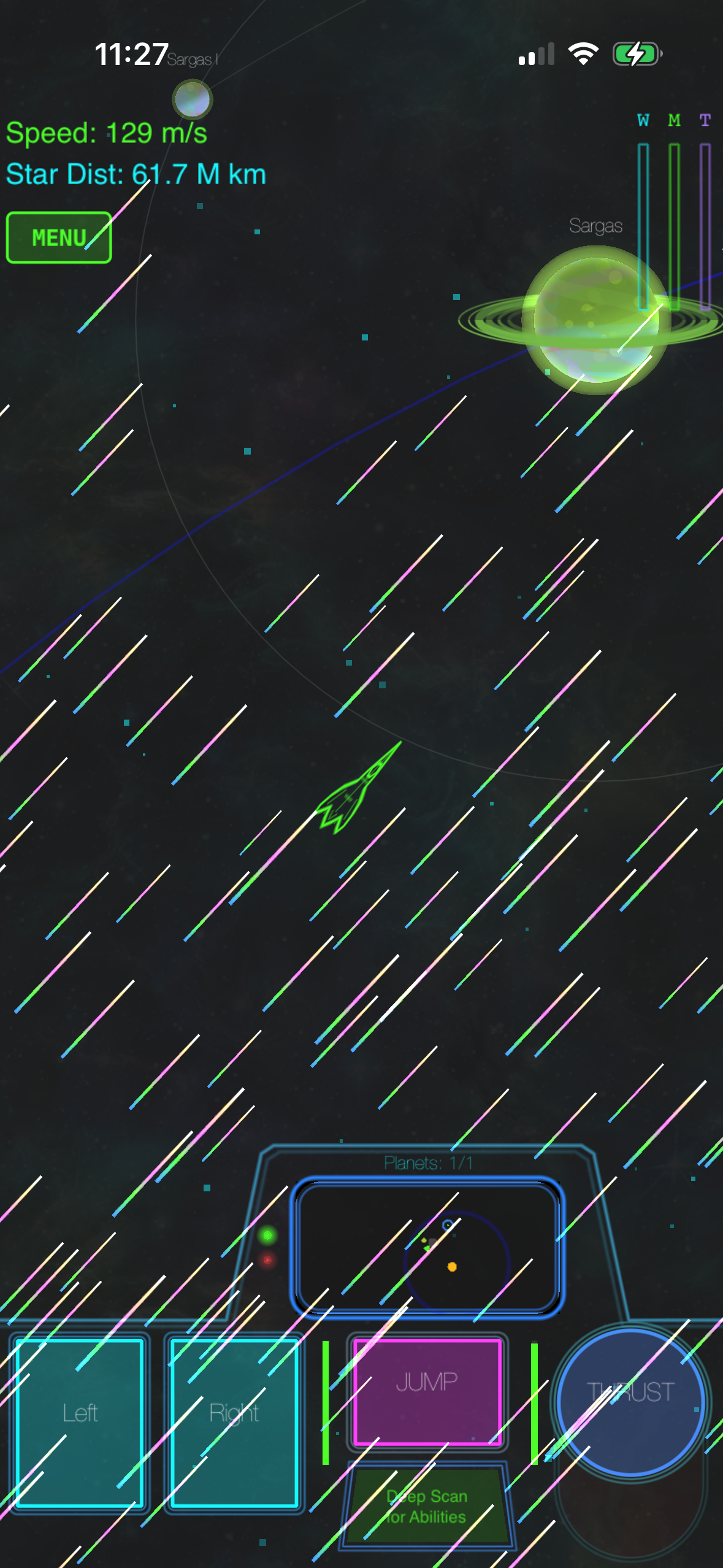
If Asteroids was about momentum, Galaximus is about gravity. Every body in the game—planets, asteroids, your ship—obeys real orbital mechanics. You don’t have a fuel tank that empties; you have a ship that falls toward every mass on screen, and you learn to use that fall as your engine.
The learning curve is real. New players expect traditional space-game controls; instead, they get a physics simulation that rewards patient positioning over twitch reflexes. Spend thirty minutes learning to read gravity, and you’ll spend hours using it. Slingshots around planets, orbital captures, fuel-efficient transfer windows—these aren’t cosmetic; they’re the core mechanic.
The arcade lineage is clear: Asteroids taught you to think in vectors and momentum; Galaximus teaches you to think in gravity wells and orbital energy. The campaign spans eight procedurally configured star systems with a structured narrative arc—a beginning, middle, and satisfying ending. Each playthrough generates unique planet configurations, so replay value comes from mastery, not grinding.
No ads. No IAP. Premium-tier pricing at, and you own it forever.
Note (as of May 2026): A major expansion called Galaximus Infinitum is in development for late 2026 (open-galaxy sandbox, planetary surface exploration, faction warfare, outpost building). Players who purchase Galaximus at the current price receive Infinitum as a free upgrade upon release; after launch, the combined game will move to a higher price tier.
Asteroid Outpost: The Five-Minute Arcade Fix
When you want Asteroids but don’t have thirty minutes to learn orbital mechanics, Asteroid Outpost delivers immediate, frantic arcade action. The formula is straightforward: waves of incoming asteroids, your turret-mounted ship at the center of the screen, survival as long as you can manage.
What keeps it from being a rote clone is the progression. Between waves, you earn points to upgrade your ship—faster fire rate, tighter turning radius, shield regeneration. The upgrades aren’t cosmetic; they’re gameplay-altering. A fully upgraded ship feels fundamentally different from a stock one, which means returning players have a reason to push deeper into the gauntlet.
The visual style is clean vector art—neon lines on black, exactly the aesthetic Asteroids would have if it shipped in 2026 instead of 1979. No clutter, no distracting UI chrome. The controls are tap-to-aim, swipe-to-thrust; they’re responsive enough that misses feel like pilot error, not lag.
No ads, no IAP. Controller support included. Average session length runs 10–20 minutes per run, depending on how far you push into the waves.
Hyperburner: Drift as Mastery
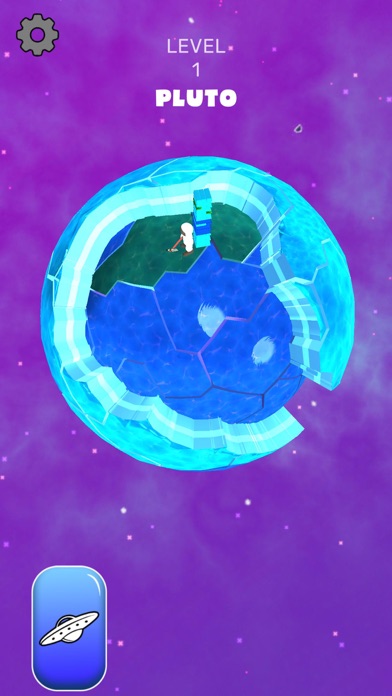
Hyperburner takes the momentum concept and wraps it in a different mechanic: drift. Your ship is always moving forward; you rotate to change direction, and the longer you hold the turn, the more your trajectory slides sideways. It’s Asteroids remixed through a drift-racing lens.
The result is a game where survival depends on reading your own momentum and predicting where your ship will be, not where it is now. Obstacles (asteroids, enemy fire, spatial hazards) aren’t meant to be dodged with twitch reflexes; they’re meant to be threaded through via patient, curved flight paths.
The minimalist vector-art style reinforces this. Neon geometric shapes on a dark background, no particle effects or screen shake to distract you from reading the trajectory puzzle. The music is synthwave—pulsing, hypnotic, the kind that makes you lean into the flow state.
Premium-tier, controller-compatible, no ads or IAP. The learning curve is gentler than Galaximus but steeper than Asteroid Outpost; it sits in a sweet middle ground for players who want to learn something new but don’t want to spend an hour on tutorials.
Starsector Mobile: Campaign-Driven Space Combat
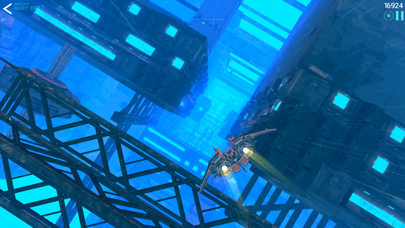
Starsector Mobile inherits from Asteroids by way of Defender—a side-scrolling space shooter where you defend positions while managing fuel and ammunition. The modern take adds a campaign layer: you’re commanding a fleet, not just piloting a single ship, and your decisions between battles matter.
The arcade combat is tight—real-time, physics-informed, with enemy AI that adapts to your tactics. But the meat of the game is the campaign. You explore a procedurally generated sector, take contracts, upgrade your fleet, manage crew morale, negotiate with factions. It’s Asteroids meets FTL: Faster Than Light—arcade action wrapped in a roguelike campaign structure.
The visual style is deliberately retro: wireframe 3D ships, simple geometric asteroids, neon-colored UI. It leans into the sci-fi aesthetic of 1980s arcade cabinets without pretending to be photorealistic. The controls scale well from touchscreen to controller; if you’re serious about the game, an MFi controller makes the combat feel significantly more precise.
Premium-tier, one-time purchase, no ads or IAP. Campaigns run 2–4 hours depending on difficulty, with procedural generation ensuring each run feels different.
Asteroids: Recharged — The Official Reimagining
Asteroids: Recharged is an official modern take licensed by Atari and developed by Adamvision Studios. It’s not a port of the original arcade ROM; it’s a thoughtful redesign that respects the lineage while adding modern visual polish and new mechanics.
The core loop is pure Asteroids: destroy rocks, avoid collisions, survive waves. But Recharged layers in power-ups, a score multiplier system, and visual effects that feel substantial without overwhelming the core gameplay. The neon aesthetic is sharp—bright lines and geometric shapes on a dark background, with subtle particle effects that reward good play without cluttering the screen.
What sets it apart is the variety. Between standard arcade mode, there are challenge modes with specific constraints (limited ammo, time pressure, invulnerability windows). These aren’t throwaway extras; they’re well-designed variants that force you to rethink your approach. Controller support is solid, and the game plays equally well on touchscreen or gamepad. Average session length runs 10–20 minutes per run.
Premium-tier, no ads, no IAP. This is the game to grab if you want the Asteroids experience with modern production values and a developer who clearly understands what made the original matter.
Why Physics Matter in Modern Arcade Games
The through-line connecting all these games is physics. Asteroids worked because your ship had momentum; the best modern descendants respect that principle. Whether it’s orbital gravity (Galaximus), drift mechanics (Hyperburner), or fleet inertia (Starsector Mobile), the games that feel most like Asteroids are the ones that make you think about movement, not just aim.
This is why free-to-play space games often feel hollow by comparison. Take Star Traders: Frontiers (free-to-play, energy-gated progression) or Galaxy on Fire 2 (free-to-play, heavy IAP push for ship upgrades)—both remove the momentum-based piloting puzzle in favor of instant input response and progression gates. When every interaction is tapped out instantly, when your ship responds to input with zero lag and zero momentum, you lose the puzzle of positioning. You’re left with pure reflex, which is fine for some games, but it’s not Asteroids. It’s not the thing that made the arcade cabinet special.
The premium-tier model matters here too. Games without energy timers, without ads interrupting your flow, without IAP pushing you toward convenience purchases—these are the ones where developers can afford to trust the player. Trust that mastery is its own reward. Trust that learning a control scheme is worth it if the game underneath justifies the effort.
FAQ
Do I need a controller to play these games?
No. All the games above work on touchscreen. Galaximus, Asteroid Outpost, Hyperburner, Starsector Mobile, and Asteroids: Recharged all support MFi controllers, but none require them. Touchscreen controls are responsive enough that controller support is a convenience, not a necessity.
Can I play these offline?
Yes. All of them work without an internet connection. You can play on a plane, in a subway, anywhere. No cloud sync, no online multiplayer, no ads trying to phone home.
Do these games have leaderboards?
Asteroid Outpost and Asteroids: Recharged track high scores locally on your device. Galaximus and Hyperburner focus on progression and mastery rather than competitive scoring. Starsector Mobile doesn’t include leaderboards but does track campaign completion stats.
How long does each game take to finish?
Asteroid Outpost and Asteroids: Recharged are arcade games without a defined ending—you play until you lose, then start over. Average session length is 10–20 minutes per run. Galaximus has an 8-system campaign that takes 4–6 hours for a first playthrough. Hyperburner is designed for short sessions but has enough depth for extended play. Starsector Mobile campaigns run 2–4 hours depending on difficulty.
What’s the difference between these and free-to-play space games?
No energy timers, no ads, no IAP. You pay once and own the full game. No progression walls that push you toward spending more money. The developers trust that the game itself is worth your time.
Which should I start with if I’ve never played Asteroids?
If you want immediate gratification: Asteroid Outpost or Asteroids: Recharged. If you want to learn something new: Galaximus or Hyperburner. If you want a campaign to sink into: Starsector Mobile.
The Modern Arcade Lineage
The best iPhone games that trace back to Asteroids aren’t trying to recreate 1979. They’re asking: what would Asteroids be if it shipped in 2026, with modern physics, modern visuals, and the freedom to add depth without energy timers or ads?
The answer varies—orbital mechanics, drift-based flight, campaign structure, official reimagining. But they all share the core insight: momentum-based piloting, when done well, creates a skill ceiling that rewards hours of practice. That’s why Asteroids still matters. That’s why these games matter.


