iPhone Games with Vector Graphics: Minimalist Gems

Photo by Jumping Jax on Unsplash
iPhone Games with Vector Graphics: A Minimalist Design Field Guide
Jeff Minter’s Tempest 4000 finally landing on iOS in late 2025 — after years of console-only availability — pulled vector aesthetics back into the App Store conversation more sharply than any single release in recent memory. It also surfaced a quieter fact: a small but consistent cohort of indie developers has been building iPhone games out of glowing lines, geometric primitives, and high-contrast wireframes for years, because the format still works. The screen is small. The lines are sharp. The eye finds the action instantly. This guide rounds up the iPhone games doing the format justice in 2026, what makes vector aesthetics hold up forty-some years after Atari first pointed an electron gun at a phosphor coating, and which titles are worth the install.
Why vector graphics still work on a phone
The original vector arcade cabinets — Asteroids, Tempest, Battlezone, Star Wars — drew their images by steering an electron beam directly along line paths instead of scanning a raster. The look that came out of that hardware constraint (pure lines, no fill, infinite resolution within the beam’s precision) turned out to be one of the most legible visual styles ever invented for action games.
On an iPhone, that legibility translates well:
- Tiny screen, fat thumbs. Vector art keeps the play field readable when half of it is under your hands.
- OLED loves it. Pure black backgrounds with glowing line work look genuinely striking on modern iPhone displays — better, arguably, than they ever did on a CRT.
- Frame rate stays high. Drawing a few hundred line segments is cheap. A vector game at 120Hz on ProMotion is butter.
- Style ages slowly. Pixel art dates. 3D from five years ago dates faster. Pure geometric line art from 1980 still looks intentional in 2026.
The trick, of course, is that vector aesthetics are easy to imitate badly. A black background and some neon strokes isn’t a vector game; it’s a wallpaper. The titles below earn the lineage.
What “vector graphics” actually means in a 2026 mobile game
Almost nothing on a modern iPhone is “true” vector in the original sense — nobody’s deflecting an electron beam. What developers mean by vector-style today is some combination of:
- Line-primary rendering — the game is constructed from strokes rather than filled sprites or 3D models.
- Geometric forms — triangles, polygons, circles, segmented paths. No textures.
- Additive glow / bloom — to evoke the phosphor-burn look of the cabinets.
- High-contrast palettes — usually a dark background and one to four saturated foreground colors.
For this article’s purposes, four of the picks below — Geometry Wars 3, Super Hexagon, Tempest 4000, Galaximus — are pure vector or close to it: line-primary rendering, geometric forms, the full lineage. Two — Mini Metro and Vectronom — are vector-adjacent: they share the minimalist geometric palette and lack of textures, but use filled polygons rather than line strokes as the primary visual element. I’ve kept them in because the design philosophy is the same one — the visuals are doing gameplay work, not decoration — but the distinction is worth naming up front rather than smuggling past you.
The shortlist: iPhone games with genuine vector craft
Six titles, grouped by what they’re best at. All are premium or premium-leaning by the standards of this publication — pay-once where possible, no ad walls, and where IAP exists it’s cosmetic or expansion-tier, not gated progression.
Geometry Wars 3: Dimensions Evolved
The most polished twin-stick shooter on iPhone built around vector primitives, full stop. Geometry Wars 3 isn’t strictly arcade-vector in lineage — it descends from Bizarre Creations’ Xbox-era series — but its visual grammar is unmistakably vector: glowing geometric enemies, particle trails drawn as fine lines, grids that warp under impact. As of this writing, the App Store listing shows a 4.3 average across roughly 2,400 ratings, though the game is no longer in active development. Touch controls are virtual sticks; they’re acceptable, not ideal, but the chaos onscreen masks a lot of input imprecision.
Best for: players who want vector-aesthetic action with modern polish.
Super Hexagon
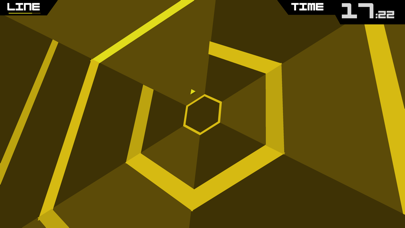
Terry Cavanagh’s reflex gauntlet is barely a game in the conventional sense — it’s a rotating tunnel of inward-collapsing line segments and a single button to swerve. But it is one of the purest expressions of vector design philosophy on the platform: every pixel onscreen exists to communicate where the safe path is. The chiptune soundtrack by Chipzel is inseparable from the experience. More than a decade after release, it remains a benchmark for “how much game can you make from lines and a beat.”
Best for: short sessions, high focus, deliberate punishment.
Tempest 4000
Jeff Minter’s Tempest lineage on iPhone is the most direct line to the original vector arcade era you’ll find. Tempest 4000 keeps the tube-shooter format intact: webs of geometric lanes, enemies climbing toward you, a rotating cursor at the lip. Minter’s signature psychedelic excess piles on top — bonus levels with sheep, palette explosions, the works — but the bones underneath are pure 1981 Atari. The touch control scheme took several iterations to land; what shipped works, with caveats around the busiest screens.
Best for: players who want the actual arcade-vector lineage, unfiltered.
Galaximus
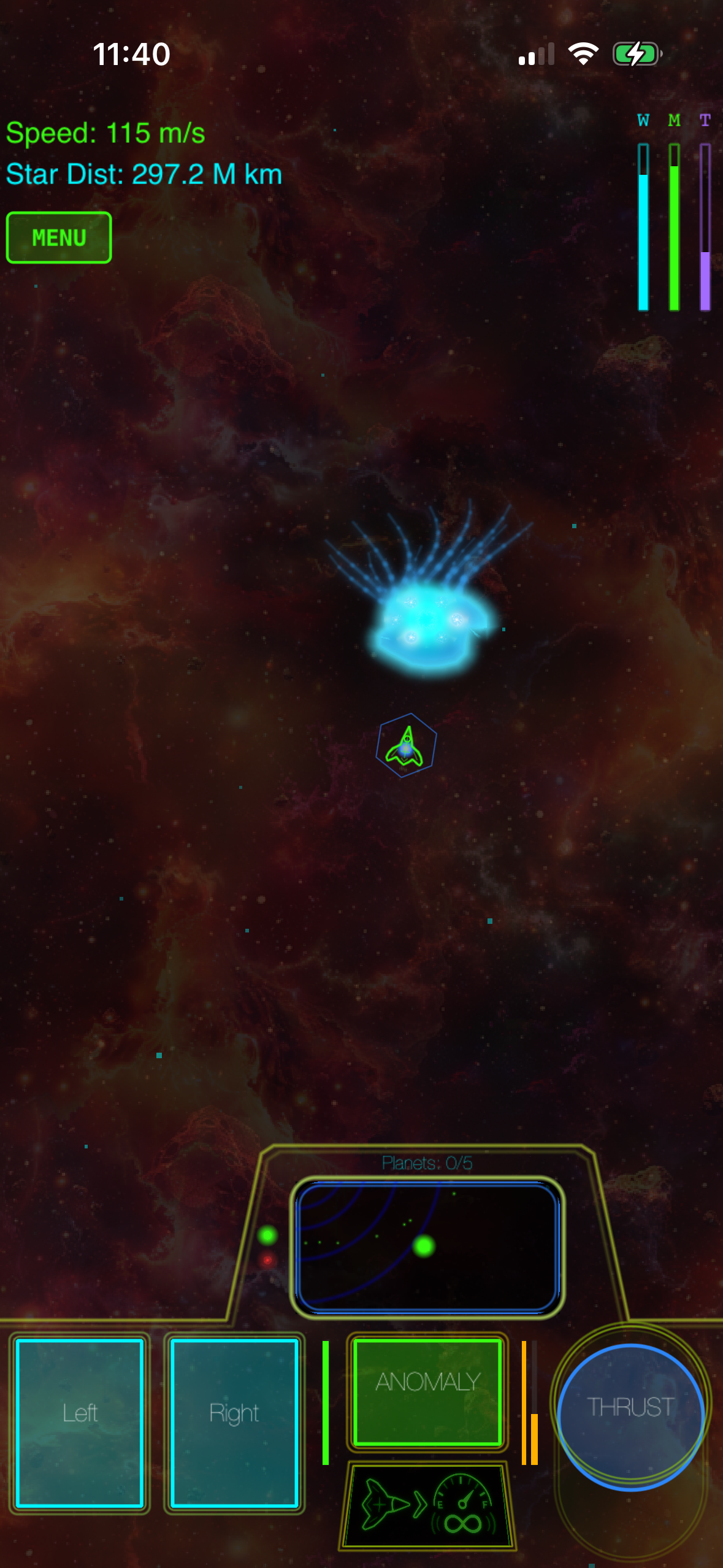
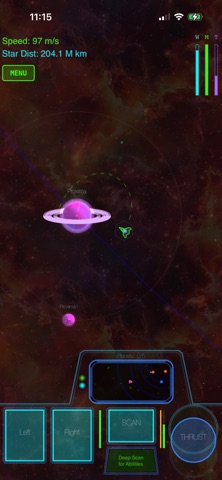
The line-art space combat in Galaximus sits closer to Asteroids and Star Castle than to modern bullet-hell shooters. Ships are rendered as outlined polygons, asteroids as rotating wireframes, and the orbital physics actually behaves as orbital physics — gravity wells curve your trajectory, momentum carries between encounters, and the game rewards reading the field over twitch reflexes. It’s a smaller game than Geometry Wars 3 in scope but more committed to the vector-arcade lineage in feel. The App Store listing confirms it’s a one-time purchase with no IAP and full offline play, which makes it a reasonable flight-bag pick.
Best for: players who like the thinking part of arcade-lineage space games, not just the shooting.
Mini Metro
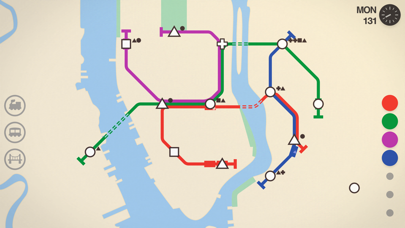
A vector-adjacent pick — strokes for subway lines, filled polygons for stations — but defensible: Mini Metro is constructed entirely from colored lines, geometric icons, and minimalist motion. There are no textures, no characters, no decorative art. It’s a puzzle game about subway routing where the visual language IS the gameplay state. Eurogamer and Rock Paper Shotgun both covered it as a standout minimalist design on release, and the iPhone port has carried that reputation forward.
Best for: commute-friendly puzzling, players who like systems they can read at a glance.
Vectronom
Also vector-adjacent: the rendering is filled flat polygons rather than line strokes, but the geometric discipline and lack of textures put it squarely in the same design family. Vectronom is a rhythm-platformer where the entire environment is a pulsing, color-shifting geometric solid that rearranges to the beat. The mobile port is short but tight, and the difficulty curve is honest. It plays best with headphones.
Best for: players who like rhythm games and can tolerate some visual chaos.
How the shortlist scores on vector-craft tests
Four honest tests, applied to the six picks. A real vector game passes most or all of these; neon-dressed lookalikes fail two or more.
| Game | Visuals = gameplay state | Scales cleanly | Color discipline | Audio matches |
|---|---|---|---|---|
| Geometry Wars 3 | ✅ | ✅ | ⚠️ (busy palette) | ✅ |
| Super Hexagon | ✅ | ✅ | ✅ | ✅ |
| Tempest 4000 | ✅ | ✅ | ⚠️ (Minter excess) | ✅ |
| Galaximus | ✅ | ✅ | ✅ | ✅ |
| Mini Metro | ✅ | ✅ | ✅ | ✅ |
| Vectronom | ✅ | ✅ | ✅ | ✅ |
Super Hexagon, Galaximus, Mini Metro, and Vectronom are the cleanest passes. Geometry Wars 3 and Tempest 4000 lean into deliberate palette chaos as part of their identity — defensible, but worth knowing going in.
The format’s limitations, honestly

Vector graphics aren’t a universal good. A few things they don’t do well, worth saying out loud:
- Narrative. It’s hard to render a face with a few line segments. Vector games tend toward abstract or systemic storytelling, not character drama.
- Spatial depth. Modern raster and 3D can render fog, parallax, atmosphere. Vector art is, by design, flat — even when it implies depth through perspective lines.
- Long sessions. The high contrast that makes vector games legible in five minutes can feel harsh over ninety. Most of the picks above are best in short bursts.
That’s not a complaint. Those constraints are part of why the format produces the games it does — short, focused, repeatable, designed for the in-between minutes of a day. The iPhone is arguably the best device anyone’s built for that kind of play.
FAQ
Can I play these games offline? Yes, all six. Geometry Wars 3, Super Hexagon, Tempest 4000, Galaximus, Mini Metro, and Vectronom all run fully offline once installed. Geometry Wars 3 and Mini Metro will sync leaderboards and progress when you reconnect, but neither requires a connection to play.
Do any of them support controller input? Geometry Wars 3, Tempest 4000, and Vectronom all support MFi and standard Bluetooth controllers (including Xbox and DualSense), and play noticeably better with one. Galaximus has partial controller support — menus still need touch. Super Hexagon and Mini Metro are touch-only by design and don’t benefit from a controller.
Which run best on an older iPhone SE versus a Pro Max? Super Hexagon, Mini Metro, and Galaximus run identically on any iPhone from the last six years — the rendering load is trivial. Vectronom and Tempest 4000 are fine on an SE but feel substantially better on a ProMotion display, where the 120Hz refresh smooths out the rhythm and rotation. Geometry Wars 3 is the only one where particle-heavy late-wave play can dip frames on older hardware; a Pro Max holds locked 120Hz throughout.
Will vector games drain my battery faster because of the glow effects? Generally no — vector-style rendering is computationally cheap, and the bloom passes are a small fraction of what a modern 3D game asks of the GPU. The bigger battery factor is screen brightness, since the high-contrast palettes look best at higher levels.


