Modern iPhone Games Like Asteroids: Arcade Classics Reimagined

Photo by Senad Palic on Unsplash
Modern iPhone Games Like Asteroids: Arcade Classics Reimagined
The original Asteroids arcade cabinet (1979) stripped gameplay down to its essence: rotate your ship, fire, dodge. No health bars. No progression systems. No timers counting down your fun. Forty-six years later, that design philosophy still works—and a handful of developers on iOS get it.
If you’re hunting for iPhone games that respect that lineage rather than just borrowing the aesthetic, the options are narrower than you’d expect. Most “retro” games on the App Store are retro-in-name-only: they slap on vector graphics and chiptune audio, then bury the experience under IAP menus and energy timers. The games below don’t do that. They’re craft-built, premium-tier titles that understand what made Asteroids matter: immediate challenge, clean mechanics, and the satisfaction of mastery.
What Makes a True Asteroids Successor
Before diving into specific picks, it helps to know what separates a genuine spiritual successor from a skin-deep homage.
Physics and momentum matter. Asteroids wasn’t about twitch reflexes—it was about managing inertia. Your ship drifted; you had to lead your shots. Modern successors either respect that (rewarding positioning and patience) or abandon it entirely (turning the game into a bullet-dodge sim). The best ones lean into physics as a core mechanic, not a throwaway detail.
Progression is optional. True arcade games don’t gate content behind level systems or cosmetic unlocks. You start at the same challenge every session. Some modern games add optional progression; the best ones make it genuinely optional—a neat-to-have, not a requirement to keep playing.
Visuals serve gameplay. Vector graphics, CRT filters, and synthwave color palettes are tools, not decoration. A well-designed game uses them to clarify what’s happening on screen, not to distract from it.
One-time purchase, no ads, no IAP. This is the floor, not the ceiling. You pay once; you get the whole game.
Best for Learning Asteroids Physics
Games in this category nail the momentum and positioning puzzle that made Asteroids tick.
Geometry Wars 3: Dimensions
This is the closest you’ll get to Asteroids with a modern coat of paint. The core loop—rotate, fire, manage your position and your ammunition—echoes the original exactly. What sets it apart is the physics implementation: your shots don’t travel infinitely; they slow and drop. That one change forces you to think about distance and timing instead of just pointing and holding fire.
The game ships with multiple geometry-based arenas (squares, hexagons, spheres), each changing how shots behave and how enemies move. The learning curve is steep but fair—you’re not fighting the controls, you’re learning the physics. The premium-tier price point means no ads interrupt a run, and no energy system cuts you off mid-session.
Voxel Blast

A 3D take on the Asteroids formula where you’re rotating through a voxel-grid arena, shooting blocks. The physics are tighter than you’d expect from a budget-tier indie title: blocks fragment realistically, your ship’s momentum carries through turns, and the challenge escalates by adding new enemy types rather than just speeding everything up.
The difficulty curve is gentler than Geometry Wars but still respects player skill—you can’t brute-force your way through later waves. The visual clarity is exceptional; even with dozens of voxels on screen, you always know what’s a threat and what’s a debris cloud.
Best for Minimalist Aesthetics and Precision
These games strip away everything but the essential shapes and let the mechanics speak.
Asteroids: Gunner
A direct spiritual successor that leans hard into the original’s vector aesthetic. The developer kept the rotation-and-fire core intact but added a twist: your gun has a limited firing arc, forcing you to position your ship more carefully. Enemies don’t just drift—they hunt. That small change makes positioning the primary skill, not reflexes.
The game respects the arcade lineage without feeling like a clone. The difficulty ramps smoothly, and there’s no paywall hiding harder modes. A premium-tier title that understands its roots.
Best for Flow-State Momentum Management
Games that capture Asteroids’ appeal through different mechanics.
Hyperburner
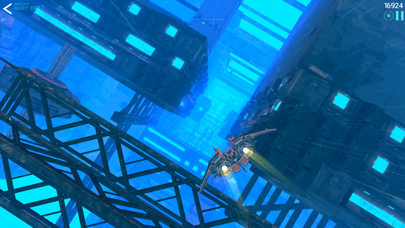
A neon-line precision runner where you’re managing momentum and positioning in a confined space, dodging obstacles at speed. While not a direct Asteroids homage, it captures the same core appeal: physics-based challenge where every failure teaches you about inertia and positioning. You can’t rotate freely like in Asteroids, but the skill—reading space, managing speed, hitting precise gaps—is identical.
The visual design is minimalist and the feedback is immediate. Every failure feels like a skill gap, not a control issue. Premium-tier, no ads, no timers.
Best for Physics-Puzzle Deliberation
These games trace back to arcade DNA but aren’t afraid to slow the pace.
Lunar Rescue
A lander-descent game where you’re managing fuel and vertical velocity to land on a shrinking platform. The physics are real—gravity pulls, fuel depletes, and every landing is a fresh puzzle. The core skill is identical to Asteroids: you’re not reacting to enemies; you’re managing momentum and position to hit a precise target. The game respects that discipline. The difficulty is unforgiving but fair, and there’s no grinding—each attempt teaches you something about the physics.
Flighty
A minimalist flight-physics game where you’re guiding a paper airplane through obstacles. The physics model is surprisingly deep—wind currents, gravity, and momentum all interact. The visual design is clean enough that you’re never confused about what’s happening, but complex enough to reward experimentation.
This sits at the intersection of Asteroids’ physics-puzzle challenge and the zen-like flow of a well-tuned game. It’s not arcade-action in the traditional sense, but it captures the same appeal: immediate challenge, no progression gating, pure mastery.
Why Modern Asteroids Games Are Rare
The Asteroids formula is deceptively hard to execute well. The original game’s appeal came from perfect balance: easy to pick up, brutally hard to master, and no way to “cheese” it with grinding or power-ups. Most modern games either lean too far into accessibility or too far into difficulty.
Games like Two Dots (accessibility-focused) strip away challenge entirely, replacing Asteroids’ skill-based progression with puzzle-solving that resets every level. Conversely, games like Flappy Bird clones push difficulty so high that a single mistake ends your run, leaving no room to learn the physics. The games above succeed because their developers understood that Asteroids wasn’t about complexity—it was about clarity. Every mechanic serves the core challenge. Every visual element clarifies what’s happening. Every difficulty spike teaches you something about the physics.
That philosophy is out of fashion in mobile gaming, where progression systems and cosmetic unlocks are the default. These games swim against that current, and they’re better for it.
FAQ
Can I play these games offline?
Yes. All listed games are fully playable offline with no internet requirement. No cloud saves, no online authentication, no surprise connectivity checks.
What’s the typical playtime per session?
Most arcade-style games here are designed for short bursts (5–15 minutes per run), though you can play longer if you’re chasing high scores. Lunar Rescue and Flighty support longer, more deliberate play sessions (15–30 minutes). None have timers or energy systems that force you to stop.
Do any of these have free-to-play versions?
No. All the games listed above are premium-tier, one-time purchases with no ads or IAP. That’s the whole point—they’re built for players who want the complete game upfront, not a freemium trap.
Which one should I start with if I’ve never played Asteroids?
Geometry Wars 3: Dimensions is the most direct translation. Hyperburner is more forgiving and teaches the same physics-management skill. Lunar Rescue is slower-paced and lets you think between moves. Pick based on whether you want fast-paced action (Geometry Wars), precision and flow (Hyperburner), or puzzle-like deliberation (Lunar Rescue).
Do these games have online multiplayer or leaderboards?
Most have local leaderboards (high-score tracking on your device). A few support cloud-based score tracking. None have real-time multiplayer. If you’re looking for competitive play, these aren’t it—they’re single-player mastery games.
The Asteroids Legacy Lives On
The original Asteroids arcade game proved that a simple mechanic—rotate, fire, dodge—could sustain hours of play if the physics and feedback were right. Forty-six years later, that’s still true. The games above prove it.
Modern game design often assumes players need progression systems, cosmetics, and constant dopamine hits to stay engaged. These games bet the opposite: that a tight mechanic, clear feedback, and genuine challenge are enough. On iPhone in 2026, that’s a radical stance. It’s also the right one.
If you’ve been chasing that Asteroids feeling on modern hardware, stop waiting for a direct port. These games are better—they understand what made the original work and built on that foundation instead of just aping the aesthetic.


