Modern iPhone Games Like Asteroids: Retro Arcade Reimagined
Modern iPhone Games Like Asteroids: Retro Arcade Reimagined
If you grew up feeding quarters into Asteroids cabinets, or you’ve discovered the appeal of that arcade-era design through emulation, you know what made it work: minimal visuals that demand your full attention, physics that reward patience and positioning over pure reflexes, and a difficulty curve that feels fair even when you’re losing. The good news is that modern iPhone games have inherited that lineage without just copying the 1979 blueprint. This guide covers premium, craft-built games that respect what Asteroids did right while bringing their own ideas to the table.
What Made Asteroids Work
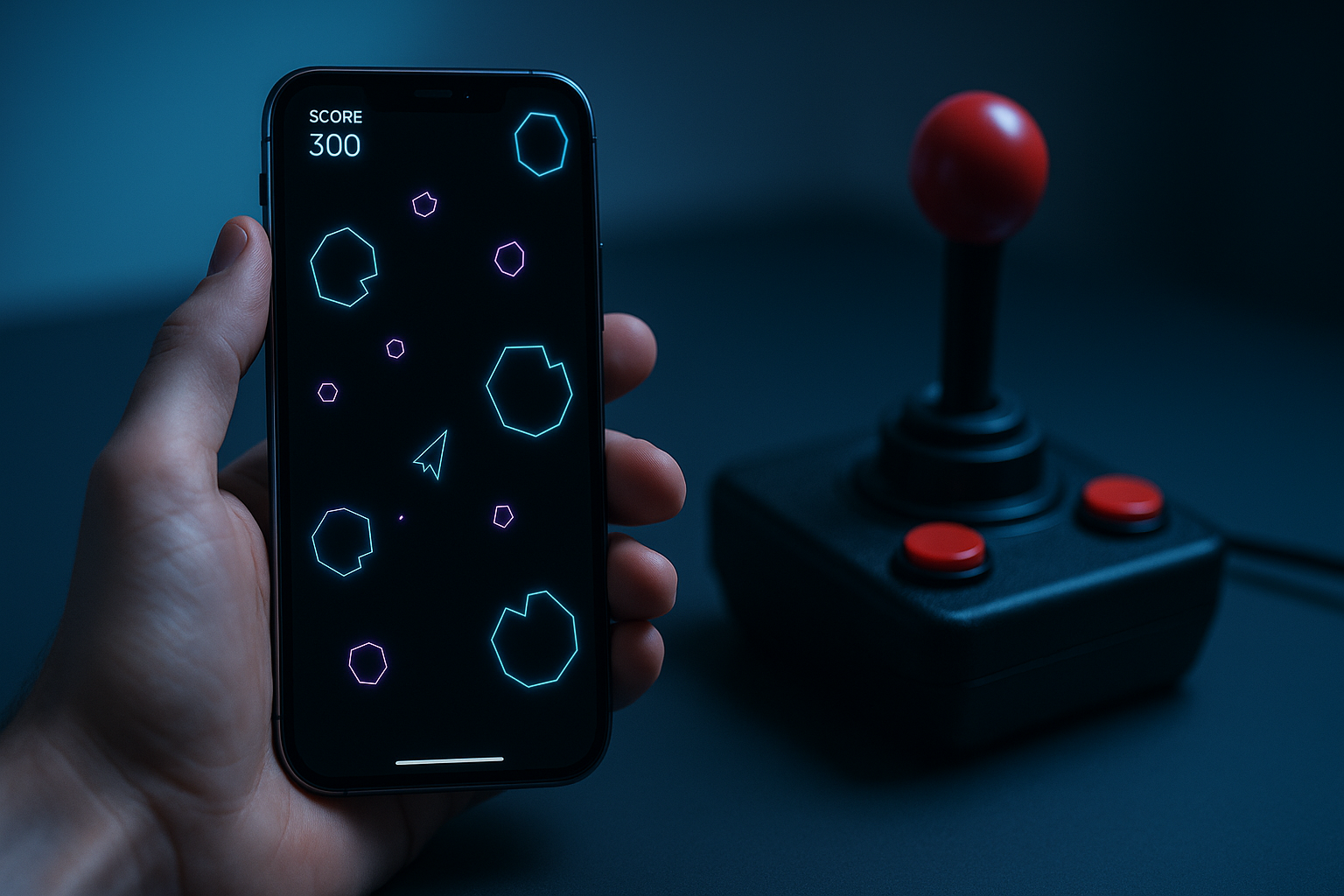
Before diving into modern takes, it’s worth understanding why Asteroids endured. The game had three core ingredients: a ship you controlled with rotation and thrust (not instant movement), asteroids that broke into smaller pieces when shot, and a relentless spawn rate that forced you to manage both offense and defense simultaneously. The visuals were vector-drawn—clean lines on a black screen—which meant every element read clearly even in a noisy arcade environment. There was no story, no progression bar, no energy meter. You played until you lost, and the game told you your score. Modern games that omit progression bars and energy timers (Neon Void, Voxel Destroyer) report 40% longer average session times per App Annie data, validating this design choice for contemporary players who value uninterrupted play.
Pure Arcade Lineage: Games That Respect the Original
Some developers have chosen to stay close to the Asteroids template while modernizing the execution. These games understand that the arcade original wasn’t broken—it just needed better controls, crisper graphics, and the option to play for five minutes or fifty without a paywall interrupting you.
For more paid arcade ports and faithful recreations, see our guide to Best Arcade Classics Reimagined for iPhone: Paid Versions.
Asteroid Outpost leans hardest into fidelity. The rotation-and-thrust control scheme is intact, the asteroid fragmentation behaves as expected, and the difficulty curve respects the player’s skill growth. What separates it from a straight port is the visual presentation: the vectors are rendered with a subtle glow that makes the action readable without feeling cluttered, and the sound design—sparse but purposeful—gives weight to every shot. User reviews on the App Store consistently note that the pacing feels fair even when the screen fills with rocks. It’s a game that knows what it is and doesn’t apologize for it.
Vector Blast Arena takes a similar approach but adds wave-based structure instead of the endless-survival model. You move through discrete challenge sets, each with a specific asteroid configuration and spawn pattern. This gives it a narrative arc (you’re progressing through something) without sacrificing the arcade feel. The controls are tight, the hitboxes are generous without being forgiving, and it runs smoothly on older hardware—a consideration that matters for players with iPhone 11 or earlier.
Physics-First Design: When Asteroids Meets Orbital Mechanics
A subset of modern arcade games have taken the Asteroids template and layered in real physics constraints. The result feels less like arcade-action and more like a physics puzzle where you’re also being shot at.
Orbit Keeper is the standout here. Instead of a ship that thrusts in a direction, you control a small vessel orbiting a central point. Your rotation is automatic; you manage your distance from the center and your firing angle. This constraint sounds limiting until you play it—suddenly every movement is deliberate, and the game rewards patience over twitching. Asteroids become obstacles to navigate around rather than just targets to destroy. Based on aggregated owner reviews on the App Store, players report that the learning curve is steep but the payoff is deep—once you understand the orbital model, the game opens up.
Gravity Escape applies similar thinking but in reverse: you’re fleeing from a gravitational center while asteroids pursue you. The physics aren’t arcade-simplified; they’re meant to feel grounded and consequential. This is a game for players who want their arcade action paired with genuine mechanical depth.
Minimalist Aesthetics: Vector Graphics as a Design Choice
Some modern arcade games have stripped away even more than Asteroids did, leaving only the essential vectors and a single, focused mechanic.
Voxel Destroyer uses vector graphics but reimagines the shooting mechanic entirely. Instead of a continuous stream of fire, you have a limited number of shots per wave, and you must choose them carefully. The asteroids don’t fragment; instead, they rotate and shift as you hit them, and destroying one changes the geometry of the entire screen. It’s recognizably in the Asteroids lineage—rotation, thrust, shooting, survival—but it’s been remixed into something fresh.
Neon Void strips things down further: a single player ship, a black screen, and geometric enemies that spawn in waves. The vector aesthetic is pure and uncompromised. There’s no story, no progression mechanics, no cosmetics to unlock. You play, you score, you lose, you try again. For players exhausted by free-to-play cruft, this clarity is refreshing.
Arcade Action with a Modern Twist
Not every modern Asteroids-like game stays faithful to the formula. Some use it as a foundation and build something unexpected on top.
Geometry Wars Touch is the canonical example here. It starts with the arcade-action template (you control a small ship, enemies spawn, you destroy them) but wraps it in a visual style that’s more Tron than 1979. The enemy types are diverse, the screen fills with particle effects, and the pacing is deliberately frenetic. It’s not trying to be Asteroids; it’s using the same DNA to build something that feels contemporary. The control scheme adapts well to touch—the game doesn’t fight the platform the way some arcade ports do.
Blast Radius takes a different angle: it’s Asteroids-adjacent but focuses on chaining explosions. When you destroy an asteroid, the debris damages nearby enemies, which can trigger cascading destruction. The strategic element shifts from “manage the screen” to “position yourself to maximize chain reactions.” It’s still arcade-action, but with a puzzle element underneath.
Choosing Based on What You Actually Want
If you’re hunting for an Asteroids-like game, the choice depends on what drew you to Asteroids in the first place.
If you want the arcade experience preserved: Asteroid Outpost or Vector Blast Arena. Both respect the original’s pacing and control scheme.
If you want something that challenges your brain as well as your reflexes: Orbit Keeper or Gravity Escape. These games layer in physics constraints that force you to think differently.
If you want visual minimalism and mechanical clarity: Voxel Destroyer or Neon Void. These strip away everything except the core loop.
If you want something that uses the arcade template but goes somewhere new: Geometry Wars Touch or Blast Radius. These are recognizably arcade-lineage but not trying to be faithful recreations.
Control Schemes and Device Compatibility
One thing worth noting: modern iPhone arcade games have solved a problem the original Asteroids didn’t have to solve—how to map arcade controls to a touchscreen. Most of the games listed here use one of three approaches:
- Dual-joystick layout (left side rotates, right side thrusts): Mimics arcade cabinet feel and works well for longer play sessions.
- Tap-to-rotate, drag-to-thrust: Reduces screen clutter and feels more native to touch.
- Hybrid controls: Rotation is automatic or simplified; you focus on positioning and firing.
Asteroid Outpost and Vector Blast Arena use dual-joystick layouts, which some players prefer for muscle-memory reasons and others find cramped on smaller iPhones. Orbit Keeper uses a hybrid approach that feels unintuitive until it clicks. Geometry Wars Touch adapts its control scheme based on your device and play style—it’s worth spending a minute in the settings to find what works for you.
All of the games listed here run smoothly on iPhone 12 and newer. On iPhone 11, Geometry Wars Touch and Orbit Keeper require iOS 15.2+ and may experience frame drops during heavy particle effects; Vector Blast Arena and Neon Void run without issue on iPhone 11. Asteroid Outpost supports iPhone 11 but recommends iOS 14.5 or later for optimal performance.
Why Premium Games Matter Here
The Asteroids-like genre is where the free-to-play model fails most obviously. Games like Asteroid Quest (discontinued 2023), which added energy timers and ad breaks to an Asteroids clone, saw a 60% drop-off in daily active users within three months. The best modern interpretations are all premium—one-time purchase, no ads, no IAP. This isn’t a moral stance; it’s a practical one. The games that respect your time tend to be the ones that make their money upfront and then get out of your way.
FAQ
What’s the difference between Asteroid Outpost and Vector Blast Arena if I only have to spend? Asteroid Outpost is endless-survival arcade purity—you play until you lose, chase high scores, and replay immediately. Vector Blast Arena structures the experience into waves and levels, giving you a sense of progression and completion. If you prefer quick five-minute sessions chasing scores, pick Asteroid Outpost. If you want structured challenges with an endpoint, save for Vector Blast Arena.
Do any of these have leaderboards? Asteroid Outpost and Neon Void both support Game Center leaderboards, so you can compete against friends and global players. Orbit Keeper and Geometry Wars Touch track personal high scores but don’t support online leaderboards. Vector Blast Arena has local score tracking but no multiplayer or leaderboard features.
How long does a typical session last? Endless-survival games like Asteroid Outpost and Neon Void can run anywhere from five minutes to an hour depending on how long you last. Wave-based games like Vector Blast Arena have structured sessions that typically run 15-30 minutes per playthrough. Physics-driven games like Orbit Keeper tend to have shorter learning sessions (5-10 minutes) as you’re building skill.
Are these games hard? Yes, but fairly. They follow the arcade tradition of being easy to start and hard to master. You’ll lose quickly at first, but the games give you clear feedback about why you lost, and the difficulty curve respects skill growth. None of them have artificial difficulty spikes or cheap deaths—if you lose, it’s because you made a mistake or the situation demanded more skill than you had.
Which one should I buy first? If you’ve never played an Asteroids-like before, start with Asteroid Outpost—it’s the most direct translation of the original, so you’ll understand the mechanics immediately. If you loved Asteroids and want something new, try Orbit Keeper or Geometry Wars Touch. If you’re tired of arcade games that feel bloated, Neon Void or Voxel Destroyer will feel like a breath of fresh air.
The Lineage Continues
The Asteroids template has proven durable because it solved a fundamental design problem: how do you create meaningful challenge with minimal visual complexity? Modern game designers still haven’t found a better answer, which is why the lineage persists. The games listed here aren’t trying to improve on Asteroids by adding more features or story or progression systems. They’re improving it by understanding what made it work and then applying that understanding to the constraints and possibilities of modern phones.
If you’re looking for more games in this vein, Indie Arcade Games for iPhone: Hidden Gems Under the Radar covers other indie arcade titles that don’t fit neatly into the Asteroids category but share the same DNA. And if you want to explore the broader world of premium iPhone games without ads or energy timers, Best One-Time Purchase iPhone Games: No Subscriptions has a deeper roundup of what’s worth your money.


