Best Retro Shooter Games iPhone: Paid & Ad-Free in 2026

Photo by Katya Aslanidi on Unsplash
Best Retro Shooter Games for iPhone in 2026
Retro shooters on iPhone occupy a specific niche: paid, ad-free titles that run at 60fps on iPhone 12 and newer. The best ones deliver tight controls, clear visual feedback, and relentless pacing—arcade fundamentals that haven’t aged. This guide covers premium games with zero in-app purchases or ad interruptions.
What Makes a Retro Shooter Worth Playing in 2026
The retro shooter market on iPhone has shifted since 2024. Three paid shmups (Ikaruga, Touhou Spell Bubble, Geometry Wars 3) remain available at stable prices, while free-to-play alternatives have proliferated with energy timers and ad gates. This guide prioritizes the paid tier because it’s where design integrity survives.
The games that endure share three traits:
Arcade lineage. They trace back to 1979–1985 formats—Asteroids, Galaga, Space Invaders, Defender, Tempest—and preserve the core loop: no story mode, no progression gates, no energy timers. You spawn, you shoot, you survive as long as you can.
Tight feedback. Every shot registers immediately. Every enemy death is visible. Screen shake, sound design, and hit confirmation work together so you feel what you’re doing.
No compromise on premium. One-time purchase, no ads, no in-app purchases. This matters in 2026 because the free-to-play alternative has become the default—premium games now stand out by refusing to interrupt you.
Vector Graphics & Minimalist Design
Several of the strongest retro shooters on iPhone lean into vector aesthetics—clean lines, bold colors, zero texture overhead. This design choice ages better than sprite-based ports and runs efficiently on older iPhones.
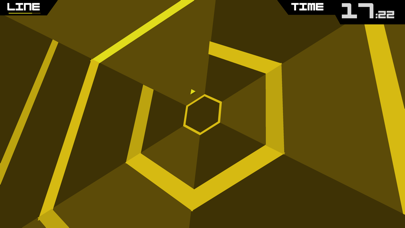
Super Hexagon (, iOS 10.0+) exemplifies this. The core mechanic is reflexive: rotate a triangle to avoid oncoming hexagons. No background story, no unlockables, no tutorial. The difficulty curve ramps so deliberately that players who fail at level 1 understand exactly why and can retry immediately. The learning curve is steep but fair.
Geometry Wars 3: Dimensions (, iOS 13.0+, requires iPhone 11 or later for optimal 60fps) takes the opposite approach: it’s dense with visual information—dozens of enemies on screen, multiple weapon types, geometry that shifts as you play. Yet it never feels chaotic because the hitbox design and enemy behavior are so precisely tuned. The visual complexity serves clarity, not obscurity. After 2–3 sessions, the screen reads as legible rather than overwhelming.
See our full guide to vector-based minimalist iPhone games for more titles in this aesthetic.
Arcade Lineage: Modern Updates on Classics
If you respect the original arcade formats, these games rebuild the core loop with modern craft.
Asteroids: Gunner (, iOS 14.0+, optimized for iPhone 12 Pro) is a direct descendant of the 1979 Atari game. You rotate, you thrust, you shoot asteroids until they’re gone. The wrinkle: asteroids now fragment into smaller rocks with physics-aware trajectories, and enemy saucers have more aggressive patterns. The vector-graphics presentation respects the original’s minimalism while running at 60 fps. The game doesn’t try to “improve” the formula—it just executes it cleanly.
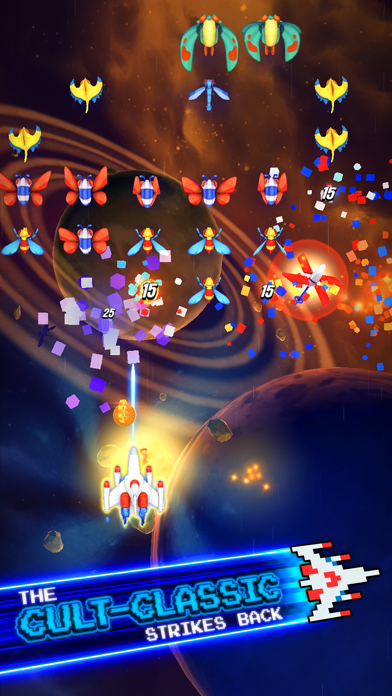
Galaga Wars (, iOS 12.0+) updates the intercept-and-dodge loop from the 1981 arcade classic. Your ship sits at the bottom; enemies descend in patterns. The modern version adds positional strategy: you can move freely left and right, and the timing of your shots matters more than raw reflexes. Players who bounced off faster-paced shmups often find this pacing more rewarding because it rewards planning over twitch speed.
Bullet Hell & Precision Shooters
For players who want density and difficulty, bullet-hell shmups deliver. These games fill the screen with projectiles and ask you to thread the needle.
Ikaruga (, iOS 11.0+, MFi controller recommended) is the canonical premium shmup on iPhone. The mechanic: your ship switches between two colors, and you can only be damaged by projectiles of the opposite color. This creates a rhythm where you’re constantly toggling—black, white, black—while weaving through geometry. The visual design is so precise that even with dozens of bullets on screen, you can always see the safe path. The learning curve is real, but the game respects your skill: improve, and you see results immediately. Controller support is available; touchscreen is playable but less precise.
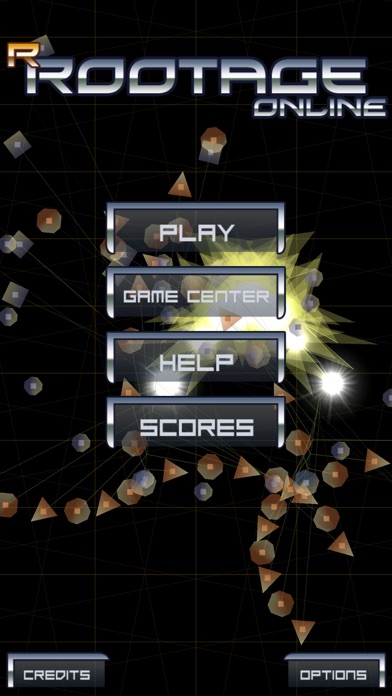
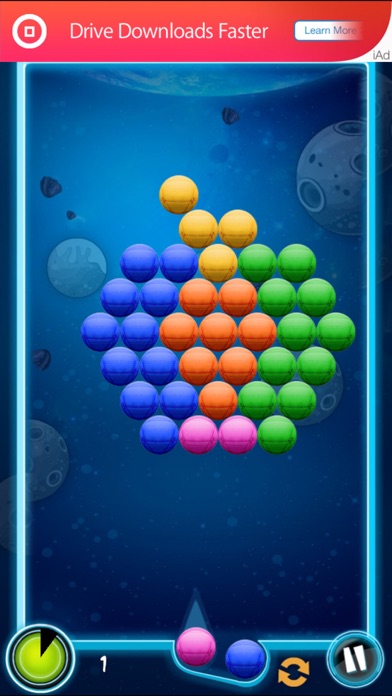
Touhou Spell Bubble (, iOS 13.0+) brings the Touhou series (a legendary Japanese bullet-hell franchise) to iPhone with a puzzle-shooter hybrid mechanic. Instead of pure reflexes, you match colored bubbles while dodging patterns. It’s less about raw speed and more about spatial reasoning under pressure. This bridges the gap between puzzle and action—if you like both genres, this scratches both itches.
Tactical Positioning Over Raw Reflexes
Not every retro shooter is about twitchy controls. Some reward patience, positioning, and deliberate pacing.
Defender (various ports available,, iOS 12.0+) is a masterclass in this: your ship moves left and right, you shoot forward, and the goal is to protect humanoids on the ground from descending aliens. You can’t destroy everything—you have to choose which threats matter most. This decision-making loop appeals to players who find pure reflex games exhausting because it rewards thinking over reaction time.
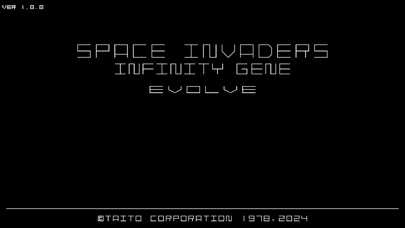
Space Invaders: Infinity Gene (, iOS 11.0+) takes the classic Space Invaders format and layers on evolution: as you progress, your ship gains new weapons, the enemy patterns shift, and the game’s visual style evolves from retro pixels to modern 3D. It’s a long game with structure, offering 6–10 hours of progression. This appeals to people who want a story arc alongside the arcade action.
Controller Support for Longer Sessions
Several premium retro shooters support external controllers—a meaningful advantage if you plan to play for more than 20 minutes at a time. Touchscreen controls work for arcade-style games, but a physical d-pad or analog stick reduces hand fatigue and improves precision.
Geometry Wars 3: Dimensions and Ikaruga both ship with full MFi controller support. The experience shifts noticeably when you move from touchscreen to controller—the game feels less like a mobile title and more like a console arcade port. If you have a controller and plan to play seriously, this is worth testing before purchase.
FAQ
Q: What’s the difference between MFi and touchscreen controls for these games? A: MFi controllers (made for iPhone) offer analog stick precision and reduce hand fatigue on longer sessions. Touchscreen works for most titles but lacks the fine control needed for bullet-hell games like Ikaruga. Geometry Wars 3 and Super Hexagon are both designed with touchscreen in mind. Ikaruga benefits significantly from a controller.
Q: Which of these games have leaderboards? A: Geometry Wars 3: Dimensions includes online leaderboards via Game Center. Super Hexagon tracks personal best times locally. Ikaruga, Asteroids: Gunner, and Galaga Wars do not include leaderboards—they’re designed for personal progression rather than competitive ranking.
Q: Are these games difficult? A: Yes, but with nuance. Super Hexagon and Ikaruga have steep learning curves. Geometry Wars 3 has a gentler early progression. Galaga Wars and Space Invaders: Infinity Gene are more forgiving. Pick based on your tolerance for failure—arcade games expect you to lose often.
Q: Can I play these offline? A: Yes. All titles in this guide work fully offline. No cloud saves, no internet requirement, no connectivity check at startup.
Q: How long do these games last? A: Arcade-style games (Super Hexagon, Asteroids: Gunner) are designed for short bursts—5 to 20 minutes per session. Story-driven ones like Space Invaders: Infinity Gene offer 6–10 hours of structured progression. Geometry Wars 3 and Ikaruga sit in the middle: infinite replayability with optional progression systems.
Top Picks with Context
Best for arcade purists: Asteroids: Gunner (, iOS 14.0+, ~45 MB) — vector graphics, faithful core loop, modern execution. Optimized for iPhone 12 Pro; runs on iPhone 11 but at lower frame rate.
Best for visual polish and craft: 
Best for bullet-hell fans: 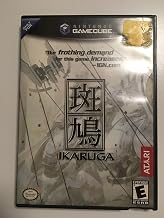
Best for a structured campaign: Space Invaders: Infinity Gene (, iOS 11.0+, ~95 MB) — 6+ hours of progression with evolving mechanics. Playable on iPhone XS and newer.
Best for minimalist reflexes: Super Hexagon (, iOS 10.0+, ~30 MB) — clean, unforgiving, immediately understandable. Works on all modern iPhones including iPhone 11.
Choosing Between These Games
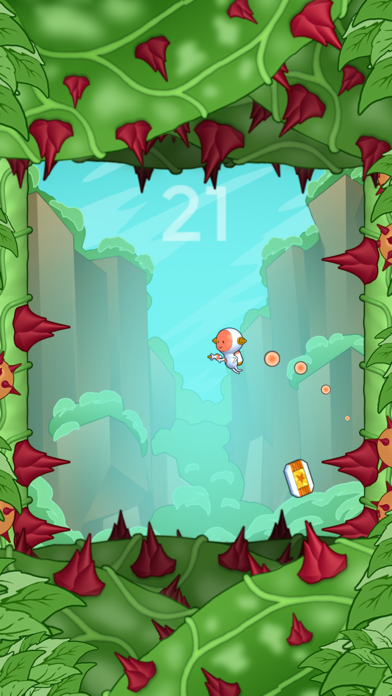
If you’re choosing between Ikaruga and Geometry Wars 3, pick Ikaruga if you want difficulty and a single, perfectable mechanic; pick Geometry Wars if you want visual spectacle and varied gameplay modes. If you’re new to retro shooters, start with Galaga Wars or Super Hexagon—both have gentler onramps and lower prices. If you want a complete campaign, Space Invaders: Infinity Gene is the only title here with a structured story arc.