iPhone Games Like Asteroids: Modern Arcade Alternatives

Photo by Ben Neale on Unsplash
iPhone Games Like Asteroids: Modern Arcade Alternatives
If you remember the arcade cabinet—the weight of the joystick, the satisfying thunk of the fire button, the hypnotic spin of a vector-drawn spaceship—you’ve probably chased that feeling on iPhone. Asteroids defined a template: rotate, thrust, shoot, survive. The formula is simple enough that it should be easy to replicate. It isn’t. Most modern takes either strip away the mechanical depth or bury it under cosmetic updates that miss what made the original work.
The games below respect that lineage. They’re not Asteroids clones; they’re games that understood what Asteroids was doing—rewarding positioning and restraint over reflexes alone—and built something new from that foundation.
What Made Asteroids Work
Asteroids succeeded because of three mechanical pillars:
Rotation-based aiming. You didn’t aim a crosshair; you rotated your ship and committed to a direction. Positioning mattered more than reaction time. A patient player who rotated into the right spot could beat a twitchy player who was always slightly off-angle.
Inertia and momentum. Your ship coasted. Firing the thruster didn’t instantly accelerate you; it added velocity over time. You had to predict where you’d be, not just react to where you are. In Orbital, if you fire your thruster for one second, your velocity continues for two to three seconds after you stop. That’s inertia. Most modern games strip this out, replacing it with instant-response controls. That’s faster, but it’s not deeper.
Score as the only progression. There were no unlocks, no level-gating, no “come back tomorrow.” You played until you died. The game got harder as your score climbed. That’s it.
Modern alternatives either honor these pillars or deliberately reinterpret them. The best ones do both.
Faithful Reinterpretations: Vector Lineage
Games that lean into the aesthetic of Asteroids—vector graphics, minimal UI, high-contrast visuals—tend to capture the feeling even when they diverge mechanically.
Geometry Wars 3: Dimensions keeps the rotational aiming and the inertia-based movement, but wraps them in a modern progression system. Waves of enemies spawn in defined arenas. You’re not fighting an infinite field of asteroids; you’re surviving escalating swarms. The visual language is neon and geometric, not monochrome vector, but the mechanical feel—the weight of rotation, the commitment of a shot, the reward for positioning—carries over.
Superhot: Mind Control Delete takes a radically different approach: it’s turn-based. You move, the world moves. This strips away reflex requirements entirely, but it amplifies the positioning and planning elements that made Asteroids rewarding. You’re still rotating into angles, still predicting trajectories, still managing a limited toolkit against overwhelming odds. The arcade lineage is there, just slowed down and made tactical.
Physics-Forward Alternatives
Some modern games abandon the Asteroids aesthetic entirely but preserve the core mechanical idea: you’re a small actor in a hostile space, and survival depends on understanding momentum and angles.
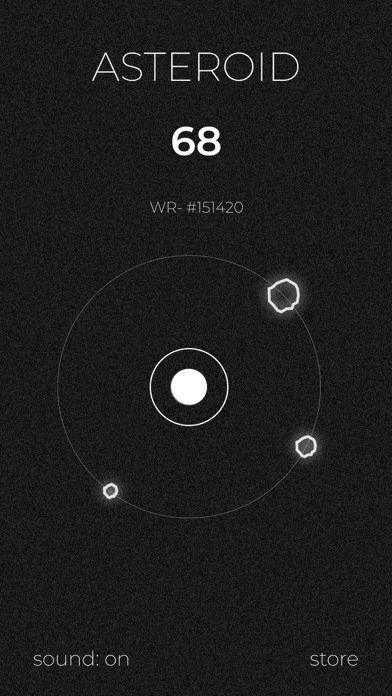
Orbital is the clearest example. It’s a puzzle-arcade hybrid where you control a satellite orbiting a planet. You don’t thrust; you adjust your orbit by burning fuel at precise moments. The game rewards patience and planning. Fire at the wrong angle and you’ll overshoot. Wait too long and your fuel depletes. This is Asteroids’ DNA rewritten in physics language. Instead of “rotate and thrust,” it’s “calculate your burn window.” The mechanical depth is identical; the vocabulary is different.
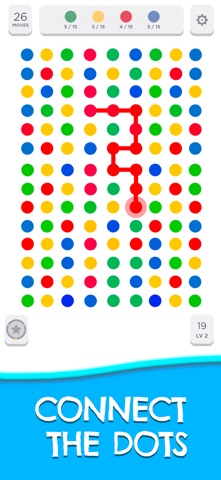
Two Dots occupies a different space entirely—it’s a puzzle game with arcade-game pacing. You’re connecting dots to clear the board, but the rules are strict and the timer is unforgiving. No energy system. No ads. Just you and the puzzle. The respect for your time is an Asteroids value transplanted into a completely different genre.
Arcade-Lineage Shooters
If you want something closer to Asteroids’ direct action—firing, dodging, managing threat—but with modern craft and no free-to-play monetization, the premium arcade-shooter space has matured significantly.
Asteroids (the straightforward port/remaster) is worth mentioning because it’s actually good. It’s not a loose interpretation; it’s a faithful translation of the arcade cabinet to touch controls, with vector graphics that respect the original aesthetic. The rotation is smooth, the thrust has weight, and the high-score chasing is exactly as hypnotic as the original.
Geometry Wars 3: Dimensions also deserves a second mention here because it’s genuinely the best modern arcade shooter on the platform. It’s not trying to be Asteroids; it’s trying to be what Asteroids proved was possible—a game where positioning and restraint beat reflexes.
The Meditative Arcade: When Slower Is Deeper
Modern alternatives to Asteroids don’t all chase speed. Some of the most interesting reinterpretations slow down the action to expose the strategic layer.
Superhot: Mind Control Delete (the iPad version, which is the definitive iOS port) is turn-based, which sounds like it would strip the arcade feeling entirely. Instead, it clarifies it. Every decision is a choice. You’re never reacting; you’re always planning. The game respects your intelligence and your time.
Orbital is meditative in a different way. There’s no timer except fuel. You can sit with a puzzle for as long as you need. The arcade lineage is there—you’re managing resources, planning trajectories, surviving a hostile system—but the pace is entirely your own.
These games prove that “arcade” doesn’t mean “fast.” It means “clear rules, high stakes, and no filler.”
What to Look For in an Asteroids Alternative
If you’re hunting for something specific, here’s what separates craft-built modern arcade games from the pretenders:
- Rotation-based aiming or equivalent positional depth. If the game lets you tap a target and auto-aim, it’s not in the Asteroids lineage. Real arcade games make you commit to a direction.
- Inertia or momentum. Your actions should have weight. Instant-response controls feel snappy, but they’re shallow. Test this by firing a thruster or projectile and watching how long the momentum persists after you stop inputting. In Orbital, a one-second burn produces two to three seconds of coasting. That’s the feel to chase.
- No energy timers or ads. If the game pauses to show you an ad or asks you to wait hours before your next play session, it’s not arcade. Arcade is “play until you die, then play again.”
- High-score or progression clarity. You should always know why you’re playing and what you’re optimizing for. Opaque progression systems are a sign of a game designed around monetization, not play.
- Respect for your time. Premium games cost money upfront and don’t ask for more. That’s the trade: you pay once, you own the full game, and the developer’s incentive is to make you want to keep playing, not to make you feel obligated.
FAQ
Are there any free-to-play games that capture the Asteroids feeling?
There are a few, but they universally compromise. Free-to-play games need monetization hooks, which means energy timers, ad breaks, or progression paywalls. These undermine the core appeal of arcade games, which is uninterrupted play. If you’re willing to pay a few dollars upfront, you’ll get a dramatically better experience.
Can I play these games offline?
Yes. All the games mentioned above work without an internet connection. This is table-stakes for premium arcade games.
What’s the difference between Geometry Wars 3 on iPad vs. iPhone?
The iPad version has a larger screen, which makes the visual feedback clearer and gives you more time to react to incoming threats. The gameplay is identical, but the experience is noticeably more comfortable on a larger display.
Do any of these games support MFi controllers?
Geometry Wars 3 and Superhot: Mind Control Delete both support MFi controllers. Asteroids, Orbital, and Two Dots are touch-only. If controller support matters to you, check the App Store listing before purchasing.
Is Superhot: Mind Control Delete really an Asteroids alternative, or are you stretching?
It’s a stretch in aesthetics but not in mechanics. The core appeal of Asteroids—positioning, planning, resource management, surviving against overwhelming odds—is all there. Superhot just removes the time pressure and makes you think instead of react. If you loved Asteroids for the strategic depth, not the twitch reflex, Superhot will click for you.
The Takeaway
Asteroids worked because it respected the player. No hand-holding, no tutorials, no monetization hooks—just a clear challenge and the tools to meet it. Modern alternatives that honor that philosophy are rare, but they exist. Whether you want the faithful remaster, the physics reinterpretation, or the turn-based tactical reboot, there’s a game on the App Store that captures what made the original matter.
The best part: they’re all premium. Geometry Wars 3, Orbital, Two Dots, Asteroids, and Superhot: Mind Control Delete. Pay once, play forever, no ads. That’s the Asteroids promise, kept.